

 Jiří Kratochvíl
 Last year was a breakthrough year for the American brand Coros in terms of hardware. Three new models were released from its lineup, which is a major step for the company.
Table of Contents
Owners of these new products may already be feeling the effects, and we’ll discuss some of them later in this article. Specifically, the brand has launched a new generation of its best-selling Coros Pace 4 model, as well as the Apex 4 in two versions and sizes. However, it all began in the middle of the year with the launch of a pilot model from a completely new product line—specifically, the Coros Nomad.
When Coros launched the Nomad last August, my first thought as a marketer was, “Wow, this is such a great ad!” I hadn’t seen anything like it in a long time, especially in the world of smartwatches. Simply put, it was a launch done right. Thanks to that ad, I immediately connected with the model so much that I knew I had to try it out.
I had my reservations, but they were put to rest thanks to my collaboration with Helveti. As a result, I had the opportunity to wear them on my wrist and hardly take them off for nearly three months. What you’ll read below isn’t just about my initial impressions of the watch and a brief test run. It’s a full-fledged, in-depth review from the perspective of a longtime Coros watch user.
Concerns That Warrant an Explanation
As I mentioned in the introduction to this review, although I enjoyed this release and found it interesting right from the start, I saw two major drawbacks—which I know I wasn’t the only one to notice—and so I feel it’s necessary to address them before we move on.
- Marketing—personally, I was thrilled by the visuals, though I didn’t really understand the emphasis on fishing at first. But the more I think about the Nomad series, the more I begin to understand it, and I hope that Coros will one day confirm my predictions—namely, that the Nomad series will focus on niche activities that require a specific approach to smartwatches. The first generation targets the fishing segment, which is a particularly popular activity—and a legitimate sport—in some U.S. states, where anglers are sponsored by major corporations; and, believe it or not, some of them have already started wearing the Coros Nomad. But if, like me, you’re not a fisherman, don’t despair. When you buy a Nomad, you’re getting, first and foremost, a high-quality outdoor watch with additional fishing features that you can easily remove from the menu.
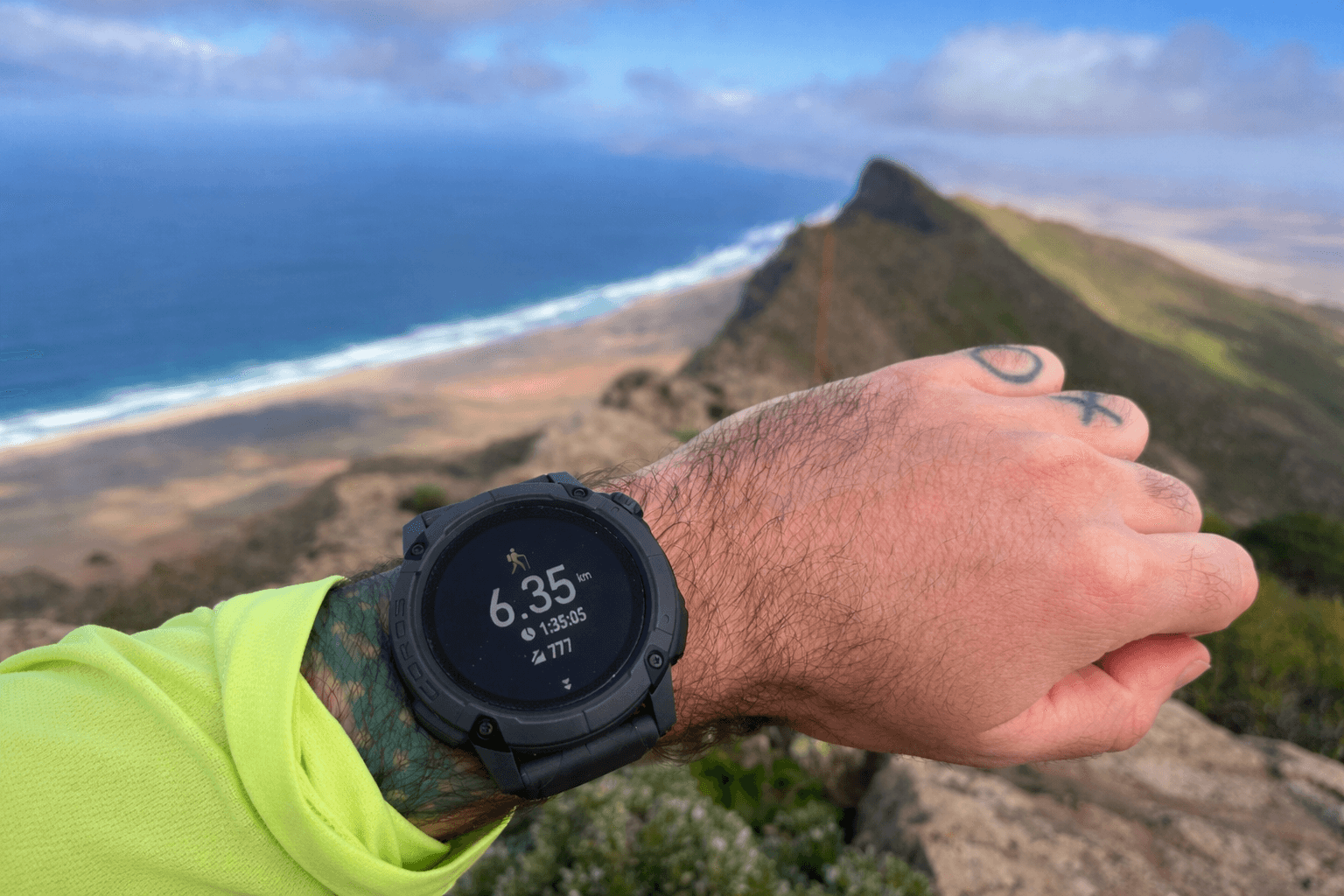
- Design — The Nomad watches are available in three colors: green, brown, and dark gray. There were concerns circulating about whether the watches would look cheap, like plastic toys. My simple answer is: they don’t. Personally, I went with the most versatile option, dark gray, and I’m blown away by the watch’s build quality. Of course, don’t expect a formal model that you could pair with a leather strap. But it’s also not a watch you should be ashamed to wear with a casual outfit to work after your morning workout. The design itself is very similar to, say, the Garmin Instinct. Die-hard Garmin fans might complain about the Nomad’s design, even though it offers much more than the third-generation Instinct. But maybe they’ve just forgotten that their beloved Instincts were, in turn, inspired by outdoor G-Shocks.
A synonym for comfort
When I put the Nomad on my wrist for the first time, my heart skipped a beat, because comfort is one of my top priorities when it comes to sports watches—and this one certainly delivers. This year marks my sixth year of wearing a Coros watch to every workout. I started with the Pace 2, then switched to the Apex 2 Pro, and for me personally, the Nomad combines the best of both worlds.
For trail running and other endurance activities—which is what I use the watch for—I need it to be lightweight, which this 61-gram watch absolutely delivers, but I also need it to be rugged enough for the outdoors, which the case diameter of around 48 millimeters also provides. In addition, for the first time ever, Coros has opted for a 24-millimeter strap with a security clasp on this model, and I have to say it was a good choice.
While the competing Suunto model left me with uncomfortable pressure marks, the Nomad fits so snugly on your wrist that you don’t even notice it’s there. Otherwise, as already mentioned, the design is a safe bet that certainly won’t offend anyone—on the contrary, it will delight every outdoor enthusiast with its proven and functional design.
News Worth Mentioning
In the world of smartwatches, where everyone is racing to see who can deliver the brightest AMOLED display, Coros has come out with a redesigned new generation of MIP displays. And why not? After all, when it comes to outdoor use, readability in sunlight and battery life are what matter most. On paper, the Nomad is rated for 22 days of normal use or 50 hours of continuous GPS navigation/activity.
My experience shows the following:
- 17–18 days of continuous wear with multiple GPS activities, including two alpine runs lasting 3+ hours and 4+ hours, as well as sleep tracking, daily stress level monitoring, and heart rate measurement every second
- 28 days if I only wear the watch for workouts or to work, but don't wear it 24/7
(Data without notifications from third-party apps enabled on the watch)
Nomady also features the latest generation of chips, which enables faster rendering of the user interface and data processing—and, among other things, introduces the ability to display street names and points of interest on maps for the first time. As is customary with Coros, these are free worldwide.
The Nomad is also the first Coros watch to feature a side button on the left side of the case. The subsequent release of the new Apex and Pac models by the end of last year then confirmed that this action button isn’t just a hardware feature of the Coros Nomad, but a prelude to new software features for the entire system across all model lines—which we’ll discuss later in this article.


The American company’s ever-improving marketing efforts are further highlighted by a new training journaling feature, which allows you to record comments using the built-in microphone, add photos taken during your workout, and view and share them in an interactive 3D model.
Upgrades to the Second Level
Anyone who knows and uses Coros watches will immediately understand what I mean by the subheading. But if you’ve ended up here while considering a new sports watch—and are perhaps thinking about a Coros, or more specifically the Nomad—it’s worth explaining.
Coros is a master of updates that, over the course of a few months, completely transform and upgrade your watch’s entire system—all for free, without any need for paid updates or the subscription model that’s so popular these days.
Since the model’s release, features such as a flashlight function—which uses the display to replace a traditional flashlight—have been added to the watch. Using the aforementioned action button, you can now switch between screens not only vertically but also horizontally while you’re active. With just one click, you can access maps—which makes navigation much easier during your activity—and, newly added, a music player. With this clever update, Coros has smartly sidestepped the need to integrate streaming platforms into its system. Now, all you need to do is connect the watch to your phone and ensure a strong Bluetooth signal.


Personally, I also think that we’re far from done with the third button, since its potential—for system shortcuts and new features, for example—is virtually unlimited.
In one of its subsequent updates, Coros also brought back the skin temperature widget—or ambient temperature measurement, if you’re not currently wearing the watch—which users had been asking for for the past year or two.
Personally, as part of the beta testing program, I had the opportunity to test new features in the Strength activity mode, which now not only detects individual repetitions more accurately, but also allows you to edit them retrospectively and add the intensity based on the weight directly during the workout, which helps better refine your training muscle map. I firmly believe that with this step, Coros is gradually getting to the heart of accurately evaluating the training load of strength training—an issue that has so far been quite a challenge for all smartwatch manufacturers.
Another nice little feature is a new addition from the latest beta testing: it uses funny animations to remind you that you haven’t moved for fifty minutes and that it’s time to, say, stretch a bit or take a drink while you’re working. That probably isn’t the main reason you should buy a Coros watch, but it’s certainly not something to complain about. Especially since Coros is now rolling out updates—big and small—every month, and thanks to my access to beta testing, I can say there’s plenty to look forward to.
Smart Features vs. Sports Features
If you’re looking for a watch designed purely for sports, the Coros Nomad won’t let you down. The notion that it’s just an outdoor watch has been shattered in recent weeks by Suguru Osako, the fastest Japanese marathoner of all time, who ran the Valencia Marathon in 2:04:54—and it’s fair to say that they look great even on a slender marathoner’s wrist paired with a road running outfit. An added bonus for its rich sports features and metrics is Coros’s own web app, Training Hub, where you’ll find countless training plans, starting with those from world-class stars and Coros ambassadors like Kilian Jornet, Alex Yee, and Jakob Ingebrigtsen.


However, if you’re looking for a watch with smart features, you’ll be a bit disappointed with the Nomad. The Nomad is, quite simply, a fitness tracker. You can play music on them during your workout, view notifications from a few select third-party apps, or read text messages, but don’t expect them to be a replacement for the Apple Watch. On the other hand, the Apple Watch won’t last two weeks of continuous use.
How does this affect your health?
Health features are becoming an increasingly popular trend in sports and smartwatches. I really like Coros’s approach in this regard. It’s simple, so it doesn’t bother you—and therefore doesn’t stress you out—if, for example, you don’t sleep well. There are other devices and tools for that.
Coros’ Wellness Check includes data on stress levels, HRV measured during sleep, sleep metrics, heart rate, SpO2, and breaths per minute, as well as VO2max. The watch thus gives you a basic picture of your condition, but unlike other devices, it provides purely factual information without unnecessary scales or ratings that might stress you out and affect how you’re feeling at the moment.
However, most people interested in Coros will still be interested in the Recovery and Sleep metrics, since this brand is primarily sought out by athletes who track this data. Recovery is measured based on your specific daily training load/activity, which is factored into your Weekly Training Load and Training Status—the latter being your seven-day training load, regardless of the calendar week.


When it comes to sleep tracking, Coros is on par with Whoop in terms of sleep detection—that is, when you fell asleep and how long you slept. The data here are virtually identical. Where Coros falls slightly short, however, is in identifying the individual sleep stages. In this regard, I actually trust Whoop more, for the simple reason that Whoop has two years’ worth of my sleep data, while I’ve slept with the Coros watch for no more than three weeks straight. Not because it’s uncomfortable, but simply because I’m so used to Coros accurately tracking what I do, and Whoop tracking how that affects my body.
If that’s all you want from a watch, the Nomad series can handle it. It does so in a subtle and purely informative way, and I like that.
Personally, from a software standpoint, the only thing I feel is missing from the app is some kind of AI feature that would help with training planning based on training and health metrics, so hopefully we’ll see that soon. Coros certainly has plenty of data for that.
Coros’ 2025 Release
Although the Coros Nomad was the brand’s first hardware launch of 2025, I have to say that it easily outshone the Apex 4 and Pace 4 models. Coros showcased a new MIP display on the Nomad, which it later used on the Apex, redesigned maps—which were later added to the Apex models—and a new action button, which it subsequently used on both subsequent releases. In doing so, the brand not only set a new direction for the watches’ design for future models and generations but also paved the way for new software features. And it chose the Nomad to do just that.
Personally, I think this is a model that—especially given its price tag of around nine thousand—makes much more sense than the 46-millimeter Apex for twelve thousand crowns, if you’re looking purely for an outdoor watch.
For an extra three thousand, the Apex—unlike the Coros—offers call functionality, slightly longer battery life, a titanium bezel, and a sapphire crystal, which, however, is less readable in direct light than a mineral crystal. On the Nomad, the glass is discreetly recessed into the case and remained completely scratch-free after three months of testing. So the question is: do you need the Apex, or is the Nomad enough for you?
The Coros Nomad has been one big surprise for me. A surprise that no one expected before the UTMB, since the community was actually waiting for the new Apex ahead of the peak of the season. It’s a surprise in terms of price, since you’d be hard-pressed to find such a feature-packed model for 9,000 crowns for outdoor use, and last but not least, it’s a surprise because of how comfortable it is to wear.
You could even say that with this adventure-focused model, Coros is repeating the same price-to-performance strategy it used with the Pace, which is now at the top of the food chain among classic running watches. We don’t yet know what this release means for the brand or the Nomad series going forward. What we do know, however, is that this is the model through which the American company has presented its vision for the next two to three years—and in the fast-paced world of smartwatches, that’s no small feat.



Comments
No one has commented on this article yet. Be the first.