

 Patrik Zdvíhal
 The Cartier Santos is one of those watches you recognize at first glance. Its angular case, distinctive bezel with eight screws, Roman numerals, and signature heptagonal crown have created one of the most iconic silhouettes in modern watchmaking. Although the Santos has more than a century of history behind it, Cartier continues to evolve its design without losing its unique identity.
Table of Contents
- Hodinky, které vznikly pro létání
- Původní chronograf byl opravdu velký
- Nový Santos Chronograph je menší. A je to dobře
- Cartier se vrátil ke klasickým tlačítkům
- Santos zůstal Santosem
- Nový číselník je ještě zajímavější než pouzdro
- Sedmdesát kroků k jednomu číselníku
- Kalibr 1904-CH MC zůstává
- Tři varianty na výběr
- SmartLink a QuickSwitch zůstávají
- 100 m voděodolnosti
- Kolik nový Cartier Santos Chronograph stojí?
- Verdikt
At first glance, it might seem like just another chronograph in an iconic case. But upon closer inspection, you’ll notice that Cartier has changed a few things that were quite significant for the previous generation. The biggest change? The chronograph has gotten smaller—and not just a little.
The previous version of the Santos Chronograph was indeed quite large. The new model moves away from the XL category and into the Large size, which is the same basic size category we’re familiar with from the classic Santos.
A watch designed for flying
The story of Santos begins as early as 1904. At that time, Brazilian aviation pioneer Alberto Santos-Dumont was grappling with a practical problem: it was inconvenient for him to take out his pocket watch while flying. Louis Cartier therefore created a watch for him designed to be worn on the wrist. The result was a model that became one of the most important milestones in the history of wristwatches.
Of course, the modern Santos is not an exact replica of the original watch. However, it retains its essential character—the geometric case and its distinctive, instantly recognizable aesthetic.

A major redesign took place in 2018, when Cartier introduced a new generation of the Santos. Among other features, this generation introduced the QuickSwitch system for quickly changing the strap and SmartLink, which allows the length of the metal bracelet to be adjusted without tools.

The original chronograph was really big
The 2020 Santos de Cartier Chronograph was a watch that certainly didn’t go unnoticed on the wrist. The case measured 43.3 mm in width, 51.3 mm lug-to-lug, and approximately 12.5 mm in height. With angular watches, dimensions are even more important than with a classic round case. This is because a square or rectangular shape visually takes up more space on the wrist. The Santos Chronograph was thus striking not only in its design but also in its sheer size.

And then there was one more unusual feature. Instead of the classic arrangement of two pushers on the right side of the case, the chronograph had only one rectangular pusher at the 9 o’clock position. This was used to start and stop the chronograph. The chronograph was reset by pressing the crown. It was an unusual solution and, at the same time, something that set the Santos Chronograph apart from most of its competitors. The new model, however, takes a different approach.
The new Santos Chronograph is smaller. And that’s a good thing.
The key dimensions of the new generation are as follows: 39.8 × 47.5 × 11.6 mm.
Compared to the previous version, the width has been reduced by 3.5 mm, the length by nearly 4 mm, and the thickness by 0.9 mm. And this is where I wouldn’t hesitate to say that Cartier made a very good decision. The difference, however, lies in the proportions. The previous chronograph was a sporty Santos in XL size. The new model looks like a Santos to which someone has added a chronograph. And in my opinion, that’s exactly the direction Cartier should have taken.

But it’s not just about the numbers on paper. A smaller case also means a shorter contact surface and a more natural fit against the wrist. Independent tests of the new generation confirm that, thanks to its new dimensions, the watch feels significantly more comfortable to wear.
Cartier has returned to classic push buttons
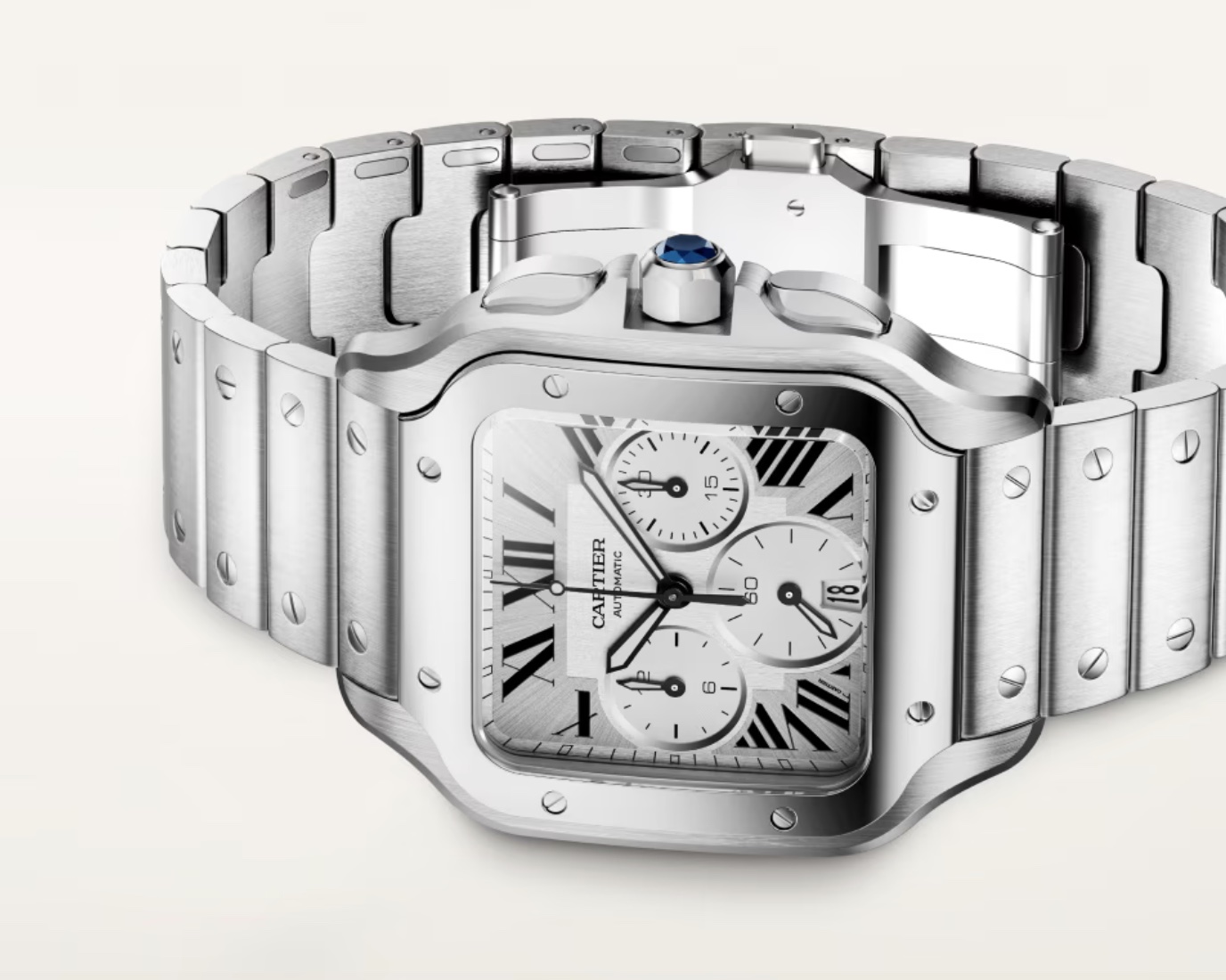
Another significant change is the chronograph controls. The unusual design of the previous generation is gone. The new Santos Chronograph features two classic pushers located at the 2 o’clock and 4 o’clock positions. The upper button is used to start and stop the chronograph, while the lower button resets it. It may be a less extravagant solution than that of the previous generation, but it makes much more practical sense.
And what’s interesting is that Cartier managed to incorporate the buttons in such a way that they don’t detract from the watch’s distinctive silhouette. Their shape and proportions echo the geometry of the case, so they don’t look like a foreign element that was tacked onto the Santos afterward. In my opinion, the result is a more harmonious whole.
Santos Remained Santos
And that’s exactly what matters. Cartier could have made much more radical changes when redesigning the chronograph. Instead, it preserved everything that makes the Santos recognizable.
The case still features the characteristic combination of brushed and polished surfaces. The bezel is adorned with screws, and its shape flows seamlessly into the case. The crown remains heptagonal and is topped with a blue synthetic spinel cabochon. For the gold version, Cartier uses a natural sapphire.
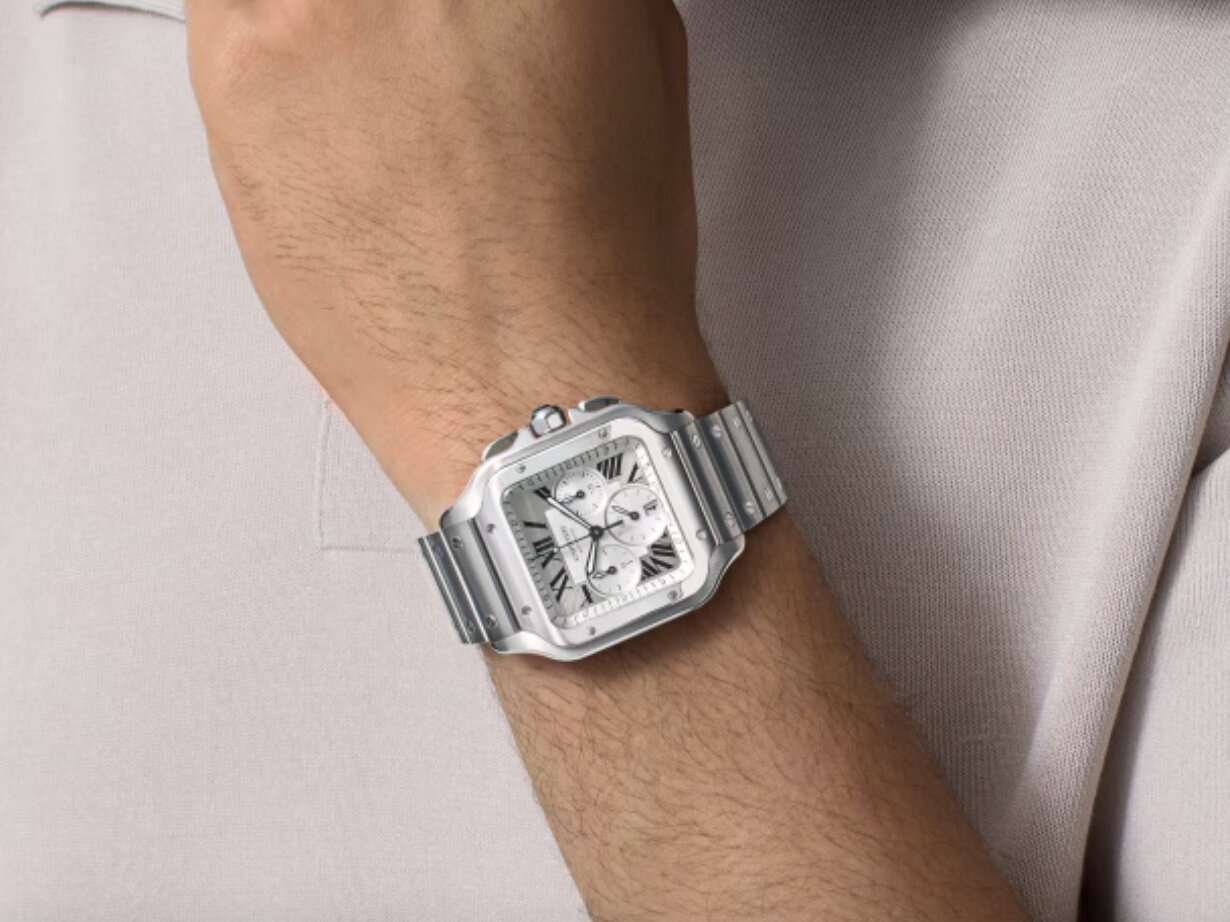
That is exactly the kind of design continuity that makes sense for an iconic watch. The Santos doesn’t need to prove that it’s modern. Its modernity stems precisely from the fact that it doesn’t have to abandon its own design language.
The new dial is even more interesting than the case
The changes weren’t limited to the case. Cartier has also redesigned the dial. The chronograph still features three sub-dials and a date window at the 6 o’clock position. However, the layout of the individual elements has changed. In the previous generation, the chronograph counters were particularly prominent. The new model tones down their visual dominance somewhat, giving more space to the small seconds sub-dial at the 6 o’clock position.

The chronograph counters are now smaller—the minute counter is at the 3 o’clock position and the hour counter at the 9 o’clock position. And this is where an interesting distinction between functionality and aesthetics comes into play. If you actually use the chronograph, larger counters would obviously be more practical. From a design perspective, however, the new layout works very well. The dial appears more balanced, and the Santos retains more space for its signature Roman numerals. After all, the chronograph on the Santos doesn’t have to look like a technical instrument. Cartier has left it with plenty of elegance.
Seventy Steps to a Single Dial
No expense was spared in the dial’s craftsmanship either. Cartier reports that the dial undergoes more than 70 production steps. It combines several finishes—the center section and the minute track feature a vertically brushed finish, while the area with the hour markers has a sunburst effect. The sub-dials are complemented by decorative rings.

Roman numerals remain one of the watch’s key visual hallmarks. The hands feature a traditional sword-shaped design and are coated with Super-LumiNova luminescent material. This is a good example of how Cartier approaches the chronograph. If we were to cover up the logo, some details might resemble those of a sports watch. But as soon as we add the Roman numerals, the distinctive bezel, and the case shape, the identity becomes immediately clear.
The Kalibr 1904-CH MC remains
If you were expecting a new movement, Cartier won’t surprise you much here. The new generation still features the 1904-CH MC caliber. It is an automatic integrated chronograph movement that first appeared in a chronograph from the Calibre collection back in 2012. It is manufactured by ValFleurier, a movement manufacturer within the Richemont Group.

It uses a column wheel and a vertical clutch—the traditional design of a mechanical chronograph. It operates at a frequency of 4 Hz and offers a 47-hour power reserve. That’s not a figure that would be considered record-breaking today. Many modern automatic movements offer 60, 70, or even more hours of power reserve. On the other hand, 47 hours is by no means a tragedy, and it’s still sufficient for everyday use.

What’s more interesting is that Cartier decided to leave the movement unchanged when redesigning the watch. And actually, that makes sense. The new Santos Chronograph didn’t need a new movement. Above all, it needed better proportions.
Three options to choose from
Cartier offers this new generation in three basic versions. The most versatile is the stainless steel model. Thanks to this, the watch has a sportier look while remaining relatively understated—at least within the world of luxury Cartier watches.


The second option is a combination of steel and yellow gold. The gold accents can be found on the bezel and the bracelet screws. In my opinion, this version works very well precisely because Cartier didn’t plate the entire case in gold. The Santos thus retains its sporty look but takes on a distinctly more luxurious character.

And then, of course, there’s 18-karat yellow gold. With this one, there’s not much to debate. If you want people to notice your watch, this is the option for you. The gold model also comes with a dark gray alligator strap, while the steel and two-tone versions offer a black rubber strap as an alternative.
SmartLink and QuickSwitch remain
Fortunately, Cartier hasn’t abandoned the practical features that have proven so successful in the modern Santos. SmartLink allows you to adjust the length of the metal bracelet without tools. This feature may sound like a minor detail, but you’ll appreciate it in everyday use. Even more practical is QuickSwitch, which allows you to quickly swap out the metal bracelet and leather strap.
On a steel bracelet, the watch has a sporty-elegant look. On a rubber strap, it takes on a more casual character, and on a leather strap, it can take on a look much closer to that of a dress watch. This means a single watch can look a little different each time.
Water resistance up to 100 m
The Santos Chronograph is water-resistant to 100 m, or 10 bar. Of course, it’s not a diver’s watch, and Cartier doesn’t market it as such. For everyday use, however, 100 m is a very reasonable rating. This means you don’t have to take the chronograph off every time you come into contact with water, and the watch can easily serve as a versatile everyday timepiece. And that’s exactly what its new size is designed for.
How much does the new Cartier Santos Chronograph cost?
When it comes to luxury watches, the question is, of course, exactly what the price range is. For the European market, the current price is around 12,000 euros for the stainless steel model, approximately 15,000 euros for the two-tone version, and around 60,000 euros for the yellow gold model.


The difference, then, is enormous. While the steel version is still a very expensive luxury chronograph—yet at the same time a model that could serve as an everyday watch—the gold Santos belongs to an entirely different category.
Verdict
What makes the Santos Chronograph particularly interesting is that it didn’t require a revolution. Cartier didn’t have to come up with a new design or a new mechanism. All it took was a look at the original chronograph and asking a few simple questions.

Does it really need to be that big? Does it have to have such an unconventional control system? And does the chronograph have to dominate the dial so much? The answer lies in the new generation.
In my opinion, the change in size is definitely a step in the right direction. At 39.8 mm × 47.5 mm × 11.6 mm, this is a very well-chosen combination for a square watch. It still has a distinctive character, but no longer looks like an oversized Santos. I also welcome the return of the classic pushers on the right side. The original design was interesting and undoubtedly had its charm, but two classic pushers are simply more intuitive. The biggest question, then, remains the chronograph’s philosophy itself.

Does the Santos need a chronograph? From a purely aesthetic standpoint, there are arguments for and against it. The Santos is one of those models where a complication can almost feel like an afterthought. The classic Santos has such a strong design that it doesn’t need any additional functions to stand out. The new chronograph works, however, precisely because Cartier didn’t try to turn it into a racing instrument. It’s still, first and foremost, a Cartier Santos. Only this time, it has a stopwatch. And with the smaller case, this version can finally appeal to customers for whom the previous XL chronograph was simply too large.
How big is the new Cartier Santos Chronograph?
The new generation measures 39.8 × 47.5 mm and is 11.6 mm thick. It is therefore significantly smaller than the previous XL model.
What movement does the Cartier Santos Chronograph use?
Inside is the 1904-CH MC automatic movement. It features a column wheel, a vertical clutch, a frequency of 4 Hz, and a power reserve of 47 hours.
Is the Cartier Santos Chronograph suitable for everyday wear?
Yes. Thanks to its compact size, 100-meter water resistance, and the ability to quickly swap out the bracelet or strap, the new generation is more versatile than the previous XL model.



Comments
No one has commented on this article yet. Be the first.