

 Jan Kobilka
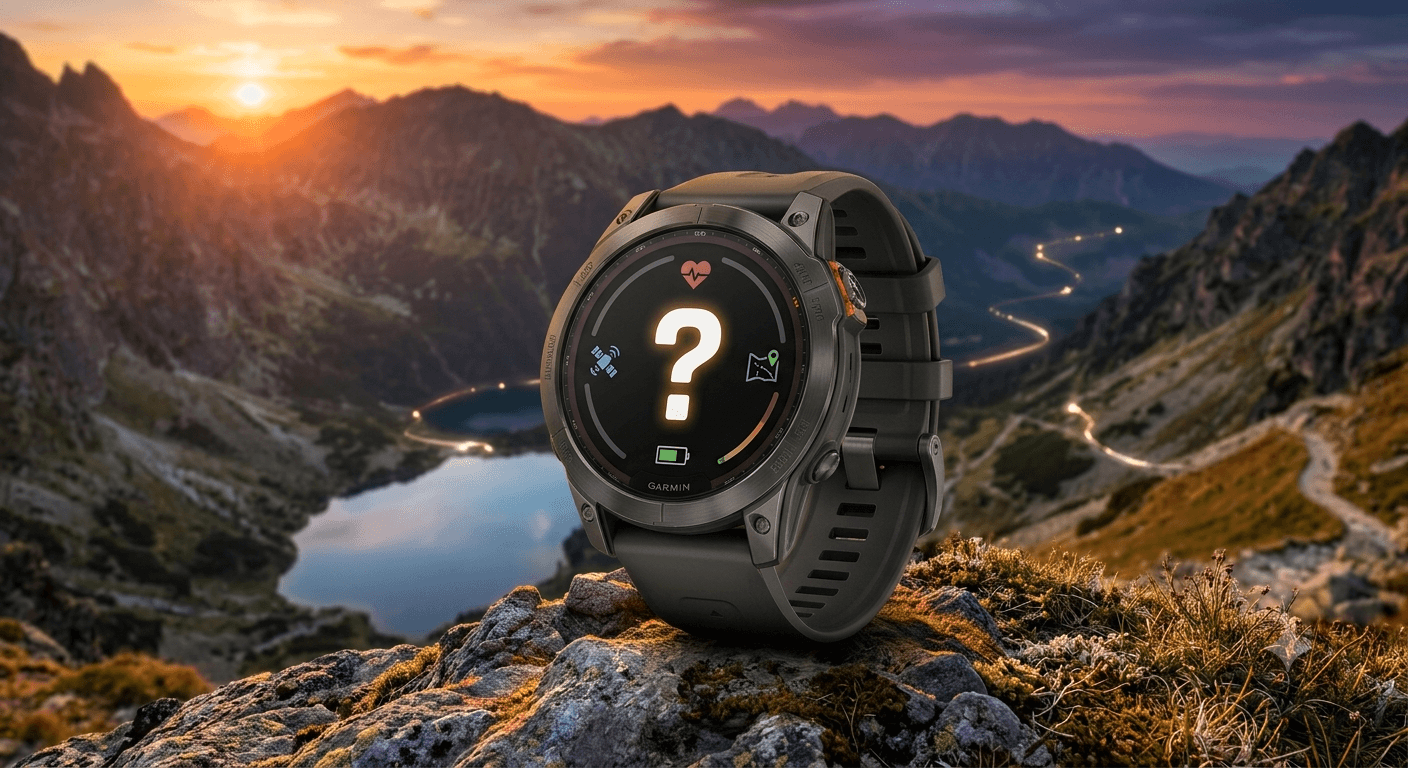
 Is it worth waiting for the Garmin Fenix 9, or should you buy the current Fenix 8? We summarize all the reliable leaks, information from certifications, and the Garmin Connect app, and explain what’s likely to change, when the new watch might arrive, and for whom it really makes sense to wait.
If you’re currently considering a Fenix and hesitating to place an order, you have a good reason. Garmin is working on a new generation of outdoor watches, and all signs point to it being unveiled by the end of the year. Below, we’ll go over what’s known so far, how reliable that information is, how much to factor in for satellite service fees, and—most importantly—what this means for your decision. The answer isn’t the same for everyone. For some, waiting will be worth it; for others, it’s a month wasted.
Table of Contents
- Proč se něco chystá
- Co uniklo a odkud
- Stopy v aplikaci a v certifikacích
- Tři modely místo dvou
- MIP solár se vrací, ale ne do základu
- Velikost 43 mm napříč řadou, solár ale ne
- Co to znamená v Česku: LTE, inReach a tarify
- Jak spolehlivé to celé je
- Kupovat, nebo počkat?
- Tři situace z praxe
- Kdy čekání nedává smysl
- Garmin CIRQA: náramek bez displeje
- Co koupit místo toho
- Co si z toho odnést
Why Is Something Happening?
Let’s start with where all this speculation originated. These aren’t images leaked from the factory, but a fairly ordinary income statement.
Garmin released its second-quarter financial results at the end of July, and they were record-breaking—with one exception. The division that includes Fenix, Enduro, Instinct, and MARQ was the only one to see a decline. By two percent—which in and of itself isn’t a disaster—but in the context of a company where everything else is growing at double-digit rates, it stands out.

Management commented on this with a statement that would go unnoticed in any other industry: the company reportedly expects stronger sales in the second half of the year due to the timing of product launches. It had already used the exact same wording after the first quarter. When the company’s CEO repeats it for the second time in a row while raising the full-year outlook, it can only mean one thing: something has to happen in the fall, or else the numbers won’t add up.
Accounting is more honest than marketing in this regard. It can’t lie, and it doesn’t even have the imagination to do so.
What leaked and from where
Garmin hasn’t officially announced anything. Everything that follows is based on leaked information.
This needs to be taken seriously, because every rumor gets a little more concrete as it’s passed along. The original wording was “the mid-range model might just get better materials.” A day later, the same thing was already being described elsewhere as a done deal: sapphire glass and titanium, period. In the meantime, no one has found out anything; the “maybe” has simply disappeared from the conditional statement.
So please treat each piece of information below as a statement from an unnamed source—not as a specification from a catalog.
Traces in the Application and in Certifications
However, a leak isn’t necessarily just someone’s claim. There are two places where the manufacturer inadvertently leaves clues, and both can be checked.
The first is the Garmin Connect app. Here’s how it works: you download the installation package and go through its contents. Garmin adds support for new watches to it before officially announcing them. It’s similar to noticing price tags in a store window for merchandise that isn’t on the shelves yet. In mid-June, the string “Enduro_4” with the internal identifier 5179 appeared in version 5.26. It wasn’t there in the previous version. This is the strongest clue we have so far, because names in the app aren’t usually random. Enduro 3 had the internal number 4575, and the connection to its successor fits.
An interesting detail that most articles omit: five weeks later, in version 5.27, the name “Enduro 4” had disappeared, and the same number was hidden under the code name “GOBI.” Someone at Garmin noticed this and cleaned it up. This actually confirms that it was a real leak rather than a change in plans. If it had been a mistake, no one would have tried to cover it up.

The second category of traces involves certification. Every device that transmits a radio signal—and watches with GPS and Bluetooth fall into this category—must undergo an approval process with the regulatory authority in each country where it is to be sold before it can be marketed. This process verifies that the device transmits only on authorized frequencies and at the prescribed power level. These databases are public, so manufacturers register their devices in them weeks before announcing anything.
There are currently four unreported Garmin devices listed there. One is registered with the U.S. FCC from late June, where the technical description indicates support for ANT+, dual-band Wi-Fi, and cradle charging. At the same time, it lacks satellite radio, so this specific model will not have the inReach feature that some people were hoping for in the new Enduro. The remaining three are in the Indonesian database; two of them were certified on the same day with consecutive numbers, which for Garmin usually means two sizes or variants of the same model. This has sparked speculation about the Fenix 9 and its larger sibling.
Three models instead of two
And now, here’s what the leaks paint a picture of. The Fenix 9 series is expected to be divided into three tiers instead of the usual two:
| Model | Display | Sizes | Satellite and LTE |
| Fenix 9 | AMOLED | 43, 47, 51 mm | no |
| Fenix 9 Pro | AMOLED or MIP Solar | 43, 47, 51 mm (MIP starting at 47 mm and up) | no |
| Fenix 9 Pro inReach | AMOLED or MIP Solar | 43, 47, 51 mm (MIP starting at 47 mm and up) | yes |
More important than the names is the classification itself, because it determines who pays extra for what.
For the current generation, the “Pro” designation essentially meant one thing: the watch supports LTE and has built-in inReach. Now it’s set to become a separate, fourth price tier. Those who want better materials but don’t need satellite functionality will get a version without it. For those who buy the Fenix 8 Pro today for its sapphire crystal and titanium and whose satellite module just sits in the case as a backup they’ve never used, this is good news.
No one knows exactly what the Pro version will add compared to the base model. The leak doesn’t say. It could be new features, or it could just be sapphire glass and a titanium bezel—in other words, what Garmin used to call “Sapphire” and sold as a variant, not a separate model. Giving the same thing a new name and moving it up a tier is standard practice in this industry.
MIP Solar is returning, but not to the starting lineup
For some customers, this is the most important line in the entire leak.
Earlier speculation suggested that Garmin would switch entirely to AMOLED and phase out transflective displays. According to more recent information, that won’t be the case. Both Pro versions are expected to offer a choice: either an AMOLED display or a MIP display with solar charging built into the glass. The base Fenix 9 is expected to stick with AMOLED only.
For those who aren’t familiar with this: MIP is a type of display that doesn’t emit light on its own. It reflects ambient light, much like paper. The brighter the sun, the better it is to see, whereas with AMOLED, it’s exactly the opposite. In exchange, it doesn’t have such rich colors or high resolution, and in dim light, it can’t do without a backlight.
The difference in battery life is noticeable in the current generation. The 47 mm Fenix 8 lasts about 16 days in smartwatch mode with the AMOLED display, but only 7 days if you leave the display on continuously. The solar-powered version of the same size lasts 21 days, and the manufacturer claims up to 28 days under real-world outdoor use. That’s a month’s worth of battery life. So if you’re the type of person who treats a charger as a consumable item on a multi-day hike, this is the only line in the entire review you need to pay attention to.
43 mm across the line, but not solar-powered
The smaller case will be available for the first time across all three models. The current Fenix 8 Pro doesn’t come in a 43 mm size at all; the only options are 47 and 51 mm. Anyone with a slimmer wrist who wanted satellite communication was out of luck and had to make a choice.
The catch: The MIP with solar charging is to remain exclusive to 47 mm cases and larger. Several articles are presenting this as a new inconvenience. It’s neither new nor a marketing decision. This is already the case with the Fenix 8: AMOLED models are available in 43, 47, and 51 mm, while solar models are only available in 47 and 51 mm. The reason is simple physics. The solar ring requires surface area, and smaller screens simply don’t have enough to make a noticeable difference in battery life.


So if you have slender wrists and want to go a month without a charger, this generation won’t deliver. Just like the last one.
What This Means in the Czech Republic: LTE, inReach, and Rate Plans
Foreign articles are silent on this point, even though it is crucial for decision-making.
LTE may not work right from the start. With the Fenix 8 Pro, it wasn’t available at all in the Czech Republic initially. Garmin didn’t fully launch the service in our country until October 20, 2025—roughly a month and a half after the watch’s release. If history repeats itself, the Fenix 9 Pro inReach may be a watch that supports satellite connectivity but not cellular networks during its first few weeks on the Czech market. It’s wise to verify this when purchasing, rather than assuming it’s the case.
The satellite service isn’t free. inReach is a subscription service on the Iridium network and won’t work at all without an active plan. There are four plans, starting at 9.99 euros per month—about 250 CZK. The most expensive plan costs 59.99 euros. The 49.99-euro activation fee is waived when you first activate the device with a new watch, and the first month is usually free.
Be aware of one detail that’s hard to find in the terms and conditions: if you cancel the plan and want to reactivate it a year later, you’ll have to pay the activation fee again. So, turning the service on and off seasonally isn’t as cost-effective as it might seem at first glance. If you want to keep the service active at all times, factor in an additional cost of roughly 3,000 CZK per year on top of the watch’s price for the cheapest plan.
Where inReach does not work. Coverage is global, with the exception of a few countries where the service is blocked for political reasons: Cuba, Iran, North Korea, Sudan, Syria, and Crimea.
How reliable is the whole thing?
We need to take this with a grain of salt, because there’s a world of difference between “the hardware exists” and “the watch will be released in September for such-and-such a price.” Certification merely confirms that functional units are somewhere in the approval process. It doesn’t reveal the release date, price, features, or even whether the model will be available in Europe at all. Garmin typically certifies devices months in advance, and not every certified model ends up in European distribution.
The string in the app is one level stronger, because the name and internal number aren’t included in the code just for fun. But even that doesn’t say when. Take a similarly cautious view of claims about an “exact two-year cycle.” Enduro 2 was released in August 2022, Enduro 3 in August 2024, so August 2026 fits nicely into the pattern. But the first Enduro arrived as early as February 2021—just eighteen months before the second one. Two instances don’t make a pattern. With a sample like that, you could prove that it always rains when you forget your jacket.
And then there’s a contradiction right within the leaks themselves. One set of reports claimed that inReach would be available across the entire Pro series. More recent reports claim it will only be available in the top-of-the-line model. Both can’t be true at the same time, so at least one of them is wrong.
In summary: a new outdoor watch is almost certainly in the works, and we’ll likely see it this year. Anything more specific—such as the name, release date, price, or features—is still just speculation.
Buy now, or wait?
Now for the important part. The answer depends on your situation, and the difference between the options amounts to quite a bit of money.
If you’ve been saving up for a Fenix and aren’t in a hurry, wait until the end of September. You’re risking very little, and you stand to gain in two ways. Either the new generation will be released and you’ll have a choice, or it won’t, and the Fenix 8 will go on sale during seasonal promotions in the meantime. The Fenix 8 isn’t going anywhere, and it won’t become outdated until its successor arrives—not before. For now, you can buy it for significantly less than at launch, which is typical for a flagship model after two years on the market.
If you have a Fenix 7 or a second-generation Epix, it’s even easier. The transition to the Fenix 8 wasn’t a major leap, and the Fenix 7 still handles everything you need. If you wait a few months, you’ll be able to choose from two generations at once: the new model and the discounted Fenix 8. Upgrading now would mean paying full price for an intermediate step.
If you need a watch within a month, don’t wait around. You have a race coming up, you’re heading to the mountains, or your old one broke. In that case, waiting is a total waste of time. Even if the new generation arrives in September, it won’t be available in the Czech market in the full range of sizes and colors until later. Moreover, the first few months after launch mean full price with no discounts and sold-out inventory. Buy the current generation—you’ll save money and have a watch that works as early as tomorrow.
Three Real-Life Situations
A multi-day ridge hike without a power outlet. Four days in the Low Tatras with the GPS running will drain the AMOLED version significantly, especially with the display in always-on mode. The solar-powered MIP model can handle this with ease. If you go on trips like this several times a year, the Pro model with MIP is the only real reason to pay extra.
Daily runs and one vacation in the Alps each year. In this case, paying extra for satellite service is debatable. Hikes in the Alps along marked trails usually have a signal, and the mountain rescue service can be reached at a standard phone number. The question isn’t whether the satellite feature is nice, but whether you want to pay for a 12-month plan just for one week. Over three years, that comes to roughly 9,000 Kč—half the price of a decent watch.

Ski mountaineering and remote areas with no cell service. Two-way satellite messaging really comes in handy right here. Plus, a standalone satellite communicator is cheaper than a watch, can be shared among a group, and you don’t have to take it off your wrist along with your watch. You’re buying a built-in module for convenience, not for a feature you wouldn’t otherwise have.
When Waiting Doesn’t Make Sense
One more thing that’s worth saying out loud, because most articles about leaks don’t mention it. This whole debate is about the flagship models—namely, the Fenix, Enduro, and possibly the MARQ. If you’re looking at the Instinct or Forerunner, none of this applies to you, and there’s no point in waiting. Those series have their own release cycles and aren’t related to the Fenix.
And with the Fenix, too, the difference between generations looks bigger on paper than it does in practice. Multi-band GPS, more accurate heart rate measurement, slightly longer battery life. Furthermore, none of the leaks so far mention a new sensor, and without a new sensor, the Fenix 9 measures exactly the same as the Fenix 8—it just displays the data more attractively. A new generation deserves an upgrade only when it adds a feature that the previous one couldn’t do at all. Plus, it always starts at the top of the price list, and discounts usually come about a year later. If price is a concern, the discounted previous generation is almost always a better buy than the new one at full price.
Garmin CIRQA: a wristband without a display
Alongside all of this, Garmin has introduced something completely different: the CIRQA Smart Band. It has no display—not even a single one. The sensor is hidden under a nylon strap, along with a single button and a status LED—and that’s it. The idea sounds like a step backward, but it’s aimed at a specific group of people: those who want to track their sleep and recovery but don’t want to sleep with a watch or wear one at work. Demand was so high that Garmin sold out its initial production run and is now quoting a five- to eight-week wait for new orders.
| Price in the Czech Republic | 4,990 CZK |
| Module Dimensions | 27.5 × 46.9 × 8.7 mm |
| Weight | 14.8 g |
| Sizes | S/M, L/XL |
| Colors | Black, French Gray, Mauve, Captain Blue |
| Endurance | up to 10 days |
| Subscription | not necessary |
That last line is more significant than it seems. Tracking sleep, recovery, heart rate, and activities is free in Garmin Connect, which is an exception in this category. At the same time, Garmin has been locking new features behind a paywall for the past few years. A Connect+ subscription unlocks AI insights, enhanced LiveTrack, a performance dashboard, and more detailed charts, and costs 8.99 euros per month—roughly 220 CZK—or 89.99 euros per year, which comes out to about 2,250 CZK. Prices are based on the euro, so be sure to check them before purchasing.
Many customers are annoyed by this shift because Garmin built its brand on an unwritten agreement: “You pay extra for the hardware, and the services are free.” CIRQA looks like a step back toward that agreement, and it makes sense. Competition in the subscription-based market for display-less fitness trackers is fierce, so “you pay nothing with us” is literally the cheapest advertising you can buy.
But here’s what to avoid: if you’re expecting the wristband to replace your watch, it won’t. You won’t see your heart rate during interval training or your pace while running, because there’s no way to display them. It doesn’t have its own GPS and gets its location from a paired phone, so it’s not enough on its own for running outdoors. You won’t get any notifications either.
And one more thing to keep in mind: CIRQA is a wellness device, not a medical device. Heart rate, variability, oxygenation, or skin temperature indicate a trend, not a diagnosis. If a number alarms you, that’s a matter for your doctor, not a discussion forum.
What to Buy Instead
If you’re interested in Fenix and don’t want to wait. Prices are approximate as of August 2026, and for discontinued models, they change practically every week.
- Fenix 8, 47 mm AMOLED. When it was first released, it cost over 25,000 Kč; today, the cheapest models can be purchased for around 17,000 to 20,000 Kč. It’s the smartest buy in the entire lineup, unless you need satellite functionality.
- Fenix 8 Solar. If battery life is your top priority, you don't have to wait for the 9. Garmin is already selling this model today, even in the 47 mm size.
- Fenix 8 Pro, 47 mm AMOLED. In the fall of 2025, it cost 29,990 Kč; today, you can find it starting at around 22,500 Kč. If you want a satellite watch and don't want to wait, here it is.
- Fenix E. A more affordable entry-level model in the series—without a flashlight or speaker, and with half the memory. Only 47 mm.
If you’re interested in a bracelet without a display, the difference between them isn’t in the price tag, as one might expect.
| Product | Price | Subscription | Note |
| Garmin CIRQA | 4,990 CZK | you don’t need | The data is synced to Connect, where you may already have a history from your watch |
| Whoop | 6,500 CZK / year | It doesn’t work at all without a membership | In the category of the most comprehensive, sophisticated recovery metrics |
| Oura Ring 4 | 10,690 CZK + subscription | required for the full range | A ring instead of a bracelet—it’s more discreet, but it gets in the way for some people when they exercise |
| Amazfit Helio Strap | 2,549 CZK | Not for basic functions | Cheaper entry point; the Zepp app is not as good as Connect |
| Your current watch | 0 CZK | nothing | It already tracks most metrics even when you wear it at night |
I really mean that last line. If you have a more advanced Garmin watch and don’t mind sleeping with it on, you’re already getting most of what CIRQA has to offer.
For the rest, calculate three years in advance—not the purchase price. A subscription costing two hundred a month adds up to over seven thousand over three years—more than the bracelet itself costs. It works the same way as with printers, where the price of the device is the smaller part of the story.
What to Take Away From This
- A new outdoor watch is in the works, and the hardware for it actually exists. It’s currently going through the approval process in four different instances, and one name has appeared directly in the app’s code.
- No one knows the date or price yet. Anyone who claims otherwise is making it up.
- The main change would be the division into three price tiers. Satellite service will become a separate item for which an additional fee is charged, both at the time of purchase and each month.
- The MIP doesn't seem to be limited to solar-powered models. For long field operations, it's still the best choice, but only in the Pro versions and only for models 47 mm and taller.
- In addition to the satellite service, you'll need to pay for a subscription plan—about 3,000 Kč per year for the cheapest one.
- The decision-making rule is simple. If you're not in a hurry and want a Fenix, wait until the end of September—you have nothing to lose. If you need a watch right away or are set on an Instinct or Forerunner, buy it now—waiting won't do you any good.
- And if you're interested in the CIRQA, the main reason is, paradoxically, what it doesn't have: a display and a subscription. For 4,990 Kč, you get access to Garmin Connect with no recurring fees—as long as you're okay with viewing your data only on your phone.
When will the Garmin Fenix 9 be released?
Garmin has not yet announced an official date. Based on leaks from certification documents, the Garmin Connect app, and statements from the company, the new generation is expected to be unveiled in the fall of 2026.
Is it worth waiting for the Garmin Fenix 9?
If you’re not in a hurry to buy, it makes sense to wait until the end of September. Either a new generation will be released, or the current Garmin Fenix 8 will drop significantly in price.
What new features will the Garmin Fenix 9 offer?
According to available leaks, the series is expected to be divided into three models, with the return of the MIP display with solar charging for the Pro versions and a separate variant featuring inReach. Garmin has not yet officially confirmed any of this information.




Comments
No one has commented on this article yet. Be the first.