

 Patrik Zdvíhal
 Most watch enthusiasts associate Jaeger-LeCoultre with the Reverso model or with the nickname “the watchmaker’s watchmaker.” Few people know, however, that at the turn of the first decade of the 21st century, the manufacture created one of the most ambitious sports watch collections in its history—the Master Compressor Navy SEALs collection.
Summer is in full swing. Temperatures are soaring to tropical levels, and most of us are looking for the one place where we can survive—by the water. A pool, a reservoir, a quarry, the sea, or the ocean. And it’s precisely at times like these that diving watches come into their own.
Table of Contents
When people hear the word “diver’s watches,” most enthusiasts immediately think of the Rolex Submariner, the Omega Seamaster, or the Blancpain Fifty Fathoms. Some might think of Seiko, Doxa, or Tudor. But Jaeger-LeCoultre? That’s the answer that catches most people off guard.
Summer, water, and… Jaeger-LeCoultre?
Today, we mainly associate Jaeger-LeCoultre with the elegant Reverso, the ultra-thin Master Ultra Thin models, or the breathtaking complications that have earned it the nickname “the watchmaker’s watchmaker.” It’s no wonder. Over the course of more than 190 years, the manufacture has supplied movements to brands such as Patek Philippe, Audemars Piguet, and Vacheron Constantin, and has created over 1,200 of its own calibers. As a result, sports watches seem more like a side note in its current portfolio.

But history tells a completely different story. In fact, Jaeger-LeCoultre was never just a manufacturer of luxury dress watches. Its most famous model, the Reverso, was not created as a design icon, but as a purely practical solution for British officers playing polo in India. The rotating case was intended to protect the crystal from impacts during a match. Functionality was more important than elegance.

And that same philosophy continued to define the brand in the decades that followed. In 1959, Jaeger-LeCoultre introduced the Memovox Deep Sea—one of the first diving watches with a mechanical alarm. At a time when dive computers did not yet exist, the alarm could signal when it was time to return or begin the ascent. Less than a decade later, the legendary Polaris followed, becoming one of the milestones in the history of diving watches. But then it was as if this chapter had simply vanished.
At the turn of the millennium, the world associated Jaeger-LeCoultre primarily with fine watchmaking: elegant models, complications, slim cases, and hand-finished details. It seemed that the era of rugged sports watches was definitively over.
But it was precisely then that one of the most interesting—and at the same time least known—chapters in the brand’s modern history unfolded.
The chapter named after the Navy SEALs
At first glance, it sounds almost unbelievable. What does a watchmaker in the Vallée de Joux have in common with an elite American special operations unit? Surprisingly, much more than one might think.
At the end of the first decade of the new millennium, Jaeger-LeCoultre decided to remind the world that it could produce not only complicated calibers but also true instrument watches—not the kind that merely pretend to be adventurous, but watches designed for extreme conditions. The result was a collaboration with the U.S. Navy SEALs and the creation of a collection known today to only a handful of collectors. And that is why it deserves to be remembered.
But first, the Master Compressor had to come along
When Jaeger-LeCoultre was working on a new sports collection at the start of the new millennium, it didn’t just want to build on the success of its famous Deep Sea and Polaris models. The goal was much more ambitious—to create a modern professional watch capable of standing shoulder-to-shoulder with the top brands of the time, such as Rolex, Omega, and IWC. That’s how the Master Compressor line was born.
It’s somewhat forgotten today, but in its day it was the technological flagship of Jaeger-LeCoultre’s sports watch lineup. The brand poured everything it considered state-of-the-art at the time into it—new materials, proprietary technical solutions, and robust in-house movements.

The Compressor Key system became its most distinctive feature. At first glance, it looks like a classic screw-down crown, but in reality, it works completely differently. Instead of turning the crown several times, all that was needed after setting the time or winding the movement was to turn the colored ring approximately a quarter turn. A white mark indicated locked, while a red mark indicated unlocked. Inside the case, a seal was mechanically compressed to ensure water resistance.
It was an elegant solution typical of Jaeger-LeCoultre. Instead of a more complicated operating system, the brand sought to simplify the user experience. The crown was quicker to operate, eliminated the risk of damaging the threads, and was more comfortable to use even while wearing diving gloves. Nevertheless, this system never gained widespread popularity and virtually disappeared after the Master Compressor line was discontinued.
Equally important was the philosophy behind the entire collection. While many luxury diving watches are created primarily to look good on a yacht or under a jacket cuff, the Master Compressor was designed from the outset as a true work tool. The matte titanium case eliminated glare, the substantial hands and bold hour markers were perfectly legible even in low-light conditions, and the luminescence was among the best Jaeger-LeCoultre had to offer at the time.

Like the brand’s other models, the Navy SEALs watches underwent the internal 1000 Hours Control testing program. Unlike COSC certification, this program tests not just the movement itself, but the fully assembled watch—including accuracy, resistance to temperature changes and shocks, and water resistance. This six-week test remains one of the hallmarks of the Jaeger-LeCoultre manufacture to this day.
This was yet another example of the approach that Jaeger-LeCoultre has long upheld. It wasn’t enough to simply produce a precise movement; the entire watch had to function seamlessly as a single unit. It was on this technical platform that a collection was later born—one that still raises questions today. Why would one of Switzerland’s most prestigious watchmakers associate its name with an elite military unit? The answer is surprisingly logical.
At the turn of 2008 and 2009, Jaeger-LeCoultre was looking for a way to demonstrate that its sports watches were not just luxury accessories, but genuine tools. The partnership with the U.S. Navy SEALs was therefore not meant to be merely a marketing campaign featuring a logo on the case back. According to the brand’s materials from that time, members of the unit participated in the development and testing of certain models, providing feedback based on real-world use.
➡️ Did you know: Jaeger-LeCoultre stated at the time that feedback from unit members helped in fine-tuning individual models. The brand never described the scope of this collaboration in detail, so it cannot be equated with the long-term military contracts of the last century. Nevertheless, it was not merely a marketing partnership without any technical overlap.
And this is where the story of the Navy SEALs models begins. Not just one watch, but an entire collection that, over the course of a few years, included an alarm watch, a chronograph, a GMT watch, watches with geographical complications, and a simpler three-hand model. Each was created for a different purpose, each appealed to a slightly different customer, and together they formed one of the most interesting—yet also one of the shortest—chapters in the modern history of Jaeger-LeCoultre.
When the Watchmaker of Watchmakers Teamed Up with the Navy SEALs
Most articles on the internet refer to “Jaeger-LeCoultre Navy SEALs watches” as if there were only one model. In reality, however, the story is much more interesting.
At the 2009 SIHH international watch fair, Jaeger-LeCoultre unveiled three new models bearing the Navy SEALs designation. Each was based on the same philosophy, but each targeted a slightly different user. One featured the legendary mechanical alarm, the second combined a chronograph with a GMT function, and the third added the Geographical complication. A year later, a simpler three-hand model was added to the lineup, which likely became the most versatile of the entire collection.

They shared not only the name of an elite American unit, but above all, their technical foundation. Titanium cases, the Compressor Key system, distinctly matte finishes without unnecessary glare, excellent readability, and robust in-house movements. These watches were designed to withstand demanding conditions while maintaining the level of craftsmanship you’ve come to expect from Jaeger-LeCoultre.
Nevertheless, the individual models differed more than might appear at first glance. And it’s no coincidence that the first one deserving our attention is neither a chronograph nor a GMT. It’s the model that best captures the philosophy of the entire collection.
Master Compressor Diving Alarm for Navy SEALs
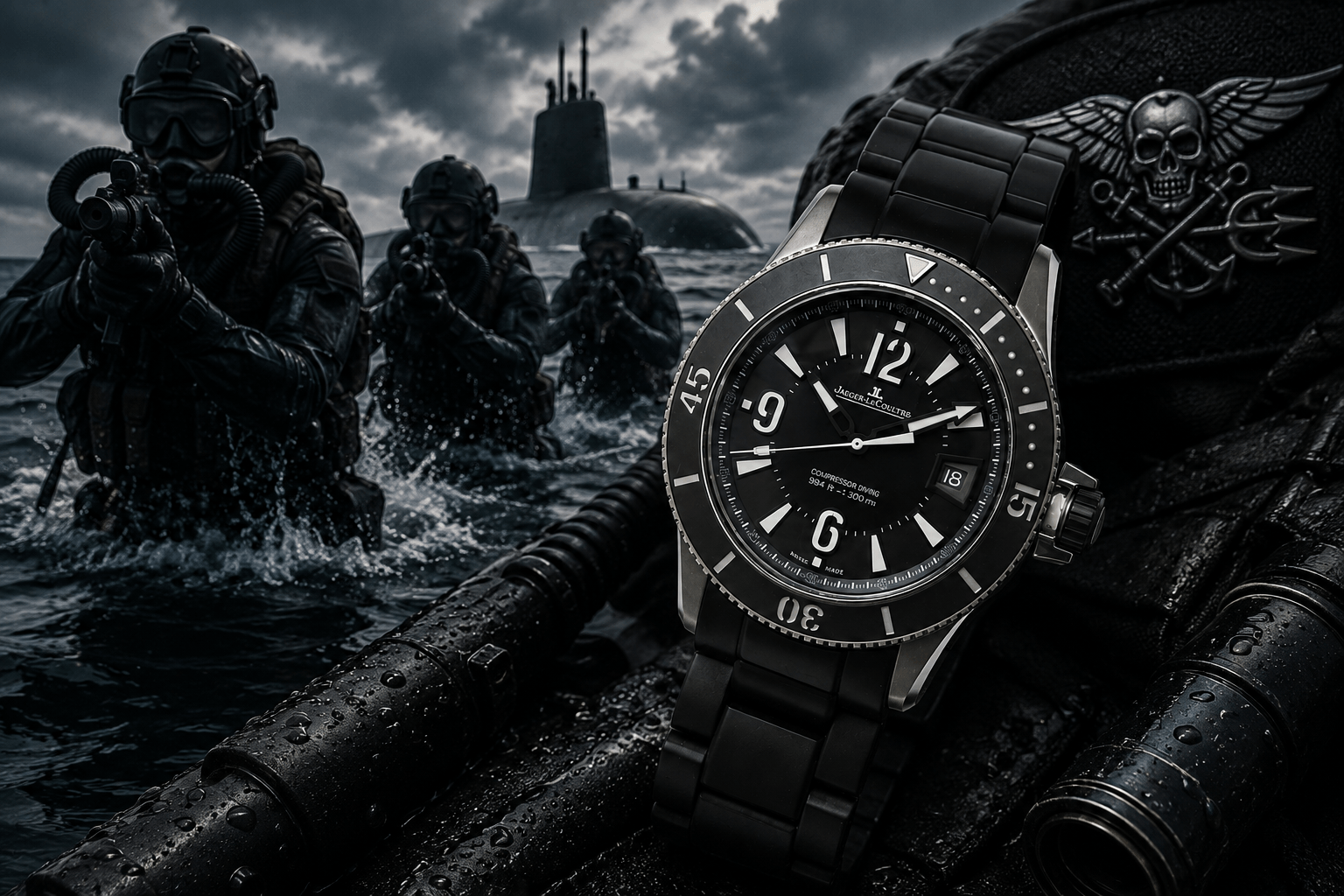
If there is one model that best carries on the legacy of Jaeger-LeCoultre’s famous diving watches from the 1950s, it is the Master Compressor Diving Alarm Navy SEALs.
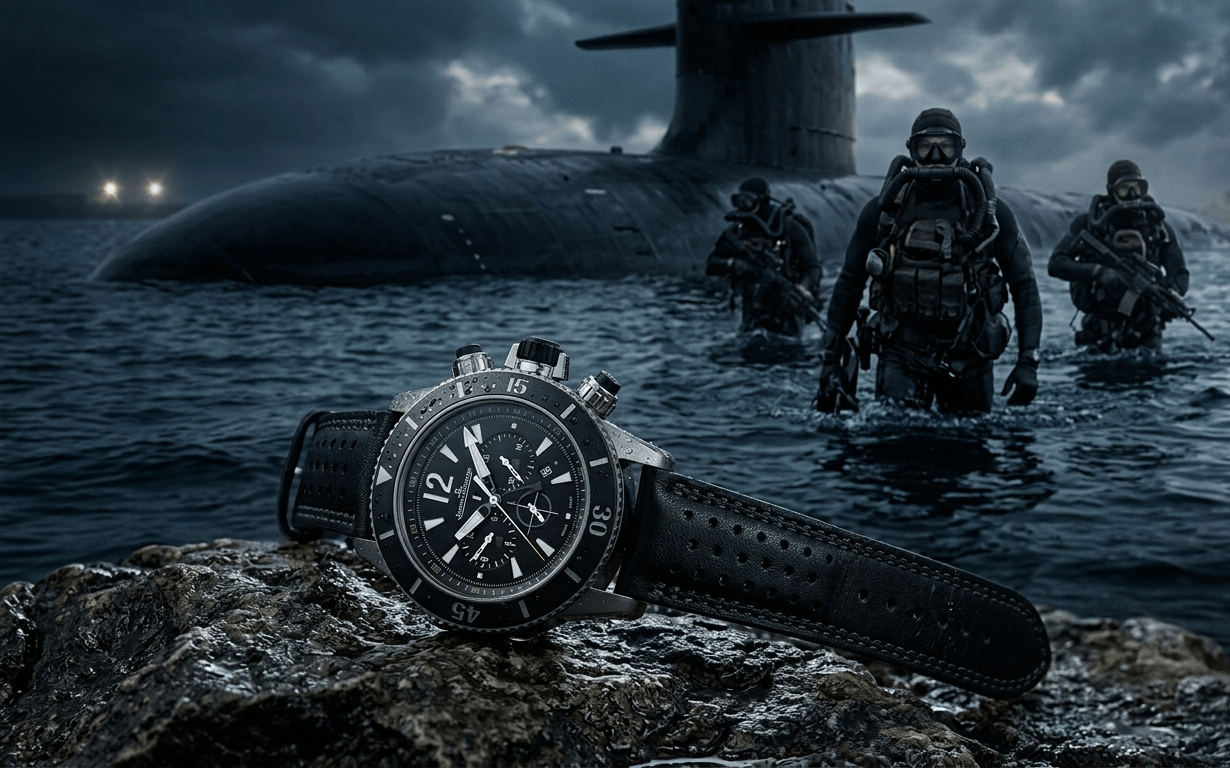
At first glance, it looks like a robust, modern diver’s watch. A 44-mm titanium case, a striking ceramic bezel, two distinctive Compressor Key crowns, and a matte finish that makes it clear that function took precedence over flash. The most interesting feature, however, is hidden inside.

While most manufacturers at the time were primarily competing to achieve the highest possible water resistance or to develop increasingly complex chronographs, Jaeger-LeCoultre decided to revive a complication that had been part of its history since 1959—the mechanical alarm.
At first glance, an alarm on a diving watch might seem strange. Today, when we have smartwatches or dive computers on our wrists, it’s easy to overlook its significance. But back in the days of the first professional divers, it was a very practical feature. The alarm served as a reminder of the time to return to the surface, the start of the ascent, or a safety stop. It wasn’t an alarm clock for waking up in the morning, but rather another safety feature for time spent underwater.

That is why the Diving Alarm model is perhaps the purest continuation of the legacy of the legendary Memovox Deep Sea. Inside, it was powered by the in-house Caliber 956, an automatic movement with a power reserve of approximately 45 hours, which, in addition to the time and date, also drove a mechanical alarm. Thanks to the case design, its sound was surprisingly audible even through the robust titanium case. It wasn’t a siren loud enough to drown out the outside world, but rather the characteristic mechanical buzzing familiar from historic Memovox models.

The rest of the features also matched its professional ambitions. Water resistance to 300 m, a unidirectional rotating bezel with a ceramic insert, strong luminescence, and perfectly legible hands were among the best that Jaeger-LeCoultre had to offer at the time. Yet the watch did not come across as overly aggressive. Unlike some of its competitors, it avoided a flashy military design. It needed neither camouflage colors nor bold lettering. Its character was much more understated. Luxurious, but not ostentatious. Technical, yet still elegant.
➡️ Did you know: Today, the Master Compressor Diving Alarm Navy SEALs is one of Jaeger-LeCoultre’s most intriguing modern models. Not because it’s an extremely rare watch, but because it’s the direct spiritual successor to the legendary Memovox Deep Sea. Collector interest has been gradually growing in recent years, and well-preserved pieces are becoming increasingly rare on the market. Its greatest feature is the mechanical alarm—a complication you’ll hardly ever find in diving watches today.
The model was produced in a limited run of 1,500 pieces, which doesn’t make it an outright collector’s rarity today, but it’s certainly not a watch you’ll come across every day. They appear relatively rarely on the secondary market, and interest in them has been gradually growing in recent years. It’s not just because of the Navy SEALs logo on the case back. Collectors are increasingly realizing that this is the last direct successor to one of the most interesting complications Jaeger-LeCoultre has ever offered in professional diving watches.
Master Compressor Diving Chronograph GMT Navy SEALs
While the Diving Alarm was primarily a tribute to Jaeger-LeCoultre’s history and the legendary Memovox Deep Sea models, the Chronograph GMT represented the future. It was not designed as a versatile diving watch. It was created to demonstrate just how far Jaeger-LeCoultre could push the boundaries of sports watch design when it refused to make any compromises.
With a diameter of 46.3 mm, the case was, at the time, one of the largest the manufacturer had ever offered. It was not a mere display of size for its own sake. The robust construction provided ample space for a complex in-house movement, high water resistance, and the distinctive Compressor Key system, which became the hallmark of the entire collection.

The Chronograph GMT was designed for customers who wanted more from a watch than just a timepiece. The chronograph allowed users to measure intervals of time, the GMT function enabled them to track a second time zone, and its water resistance of 1,000 meters made it clear that this was more than just a luxury sports accessory. It was one of the most technically ambitious diving watches that Jaeger-LeCoultre had ever mass-produced.
At the heart of the watch was the in-house Caliber 757, featuring automatic winding and a power reserve of approximately 65 hours. Although it was a complex movement, the designers did not overlook the most important aspect—readability. The layout of the dials appears balanced, the GMT hand does not interfere with readability, and the distinctive luminescence ensures excellent visibility even in low-light conditions. From today’s perspective, it may come as a surprise just how bold the Chronograph GMT appears. At a time when most luxury sports watches strive to be versatile, this model was the exact opposite. It did not try to please everyone. It was neither subtle nor unobtrusive.

The Chronograph GMT isn’t just a larger version of the Diving Alarm model. It’s the flagship of the entire collection. With this watch, Jaeger-LeCoultre wanted to demonstrate that it can create not only some of the finest complicated watches, but also an exceptionally capable professional tool.
To be continued tomorrow
In the second part, we’ll take a look at the Pro Geographic and Automatic models, the rare boutique editions of the Incursion, the Spanish limited edition, and why Jaeger-LeCoultre ultimately brought this remarkable chapter of its history to a close.


Comments
No one has commented on this article yet. Be the first.