

 Jan Kobilka
 Garmin has unveiled the Fenix 9, and at first glance, everything is exactly as it should be. A new mapping engine, 50% more RAM, an all-titanium case on the Pro series, 64 GB of storage, and several new features. Reviews agree that this is the best Fenix ever, and in a sense, they’re right.
But almost everyone is comparing it to the Fenix 8—a model that Garmin released in August 2024. In the meantime, there was actually another Fenix model. It was called the Fenix 8 Pro; it was released in September 2025 and started at 29,990 CZK in the 47mm version, 32,490 CZK for the 51 mm model, and exactly 48,990 CZK for the version with a MicroLED display. At the time, it was the most expensive and best-equipped Fenix Garmin had ever sold in the Czech Republic. And when reading this year’s reviews, you often get the feeling that this model never even existed.
This isn’t just a detail. This is the entire article.
Table of Contents
- Ve zkratce
- Proč všichni srovnávají se špatnými hodinkami
- Mapy jsou rychlejší, systém ne vždy
- Seznam oprav, ne seznam novinek
- MicroLED zmizel po jedné jediné generaci
- Jedenapadesátka a rozměry: kdo vlastně zhubl
- Výdrž stoupla, ale zázrak nečekejme
- První firmware, první nervy
- Třetí generace se stejným senzorem
- MARQ může být letos zajímavější, než se zdá
- Novinky dostane i osmička a osmička Pro
- Ceny v Česku: dobrá zpráva pro nové zákazníky, horší pro ty loňské
- Jedna drobnost, kterou v zahraničních recenzích nenajdete
- Kdo by měl Fenix 9 koupit
- Verdikt: Garmin, který ještě není úplně hotový
In a Nutshell
- • The Fenix 9 is almost always compared to the Fenix 8, not the Fenix 8 Pro. Garmin set it up that way, and journalists have followed suit.
- Compared to the 8 Series Pro, the change is significantly smaller than the new generation suggests.
- The MicroLED display disappeared from the product lineup after just one generation.
- The Elevate Gen 5 optical sensor is now in its third consecutive generation as the flagship model.
- The titanium case, 64 GB of storage, and the return to the 43 mm size are real improvements. The rest is debatable.
- Prices in the Czech Republic are surprisingly reasonable this year. The base 9-series starts at 24,490 CZK, which is lower than the 8-series.
- Garmin no longer offers vouchers for TOPO Czech V5 maps for the 9 series.
Why Does Everyone Compare It to a Bad Watch?
Let’s start with the figures that Garmin itself included in its press release.
According to the manufacturer, map scrolling is up to 30% faster than on the Fenix 8. It has 50% more RAM than the Fenix 8. The display is twice as bright as on the Fenix 8. Storage capacity is double that of the Fenix 8. And then there’s one single number that Garmin compared to another model. Loop route calculation is 40% faster than on the Fenix 8 Pro.
Take another look at this. When a comparison with a two-year-old model is appropriate, they use the Fenix 8. When they find a single category where it holds up well even against last year’s flagship model, they use the Fenix 8 Pro. That’s no coincidence—it’s the work of the marketing department. And it’s a job well done, because these exact numbers then appeared in virtually every review, including those that appear critical.
The problem is that the vast majority of people considering the Fenix 9 today don’t own a Fenix 8. They have a Fenix 7, a Fenix 8, or a Fenix 8 Pro—or they don’t own one yet. And for owners of the Fenix 8 Pro—that is, people who spent thirty to forty-nine thousand crowns at the store last year—information about how much faster the new generation is than a two-year-old model is absolutely useless. When you look at it from this perspective, this year’s generation starts to look completely different.
Maps are faster, but the system isn’t always
It’s clear that Garmin has really been working on the maps. A new map engine, more memory, and—according to available information—a newer processor in the Pro series. Scrolling and rendering the map are noticeably faster in some situations than with the previous generation, and the calculation of a loop route is finally fast enough to be appreciated in the field.
However, navigating the menu can still be choppy, much like with the Fenix 8 Pro. The watch sometimes seems to pause for a moment after each command. At certain zoom levels, rendering takes a surprisingly long time, and there are even errors in the map display, including instances where street names don’t appear even though they’re clearly present in the map data.

Furthermore, independent tests of display and map response times show that the Fenix 9 Pro still lags behind competitors from Suunto and Coros in this area. Not by a fraction, but noticeably. And for a watch whose main selling point is map functionality, that’s a pretty significant finding.
This is particularly ironic in Garmin’s case. The Fenix 9 is meant to be, first and foremost, a mapping tool. Garmin is, after all, a mapping company. When a map loads faster but some of its information isn’t displayed correctly, and the overall user experience remains slower than that of cheaper competitors, the question is whether we’ve solved the problem or just pushed it a little further down the line.
So the Fenix 9 isn’t a story about Garmin finally making a perfectly fast watch. It’s more of a story about Garmin tackling issues that have long needed to be addressed. Some of them turned out really well. Others haven’t yet. And a few of them broke in the process.
List of fixes, not a list of new features
We need to be fair here, because there are several changes, and they’re important.
The Pro series features an all-titanium case—meaning it’s made entirely of the metal all around, not just a titanium bezel and back cover like the Fenix 8 Pro. Storage has doubled from 32 to 64 GB. The map engine is new. Features such as Garmin Epic, Stamina Zones, and Stamina Curve have been added, along with expanded options for rucking, rowing FTP and VO2 max, and the ArcheryX profile. And then there are two things that deserve special attention, because reviews refer to them as new features, even though they’re actually something else.
The first is satellite communication and LTE via inReach. This isn’t new. Garmin introduced it with the Fenix 8 Pro in September 2025, and at the time, it was the main reason that model existed in the first place. With the Fenix 9 Pro, it has been extended to the 43mm version as well, which is a real improvement, but it’s certainly not a generational innovation.
The second point is even more interesting. The Fenix 8 Pro wasn’t available in a 43 mm size and didn’t come in a solar MIP variant. At the time, Garmin explained this by saying it couldn’t fit an LTE antenna into the smaller case. The Fenix 9 brings both of these features back. That’s undoubtedly good news. But we need to be precise: The Fenix 9 isn’t pushing the boundaries here; rather, it’s correcting the regression that Garmin brought upon itself a year earlier. And that is precisely the problem with this year’s generation. Much of what looks like progress is actually a return to a state that has already existed.
MicroLED disappeared after just one generation
And now we come to a feature that most reviews either dismissed with a single sentence or didn’t mention at all. The Fenix 8 Pro MicroLED was the world’s first watch with a MicroLED display. Four hundred thousand individual diodes, 4,500 nits of peak brightness, and no risk of burn-in. Garmin touted it as a technological milestone and charged 48,990 CZK for it in the Czech Republic. That was 16,500 Kč more than the same watch with an AMOLED display and roughly double the price of a standard Fenix 8. It was September 2025.
In August 2026, Garmin is launching a new generation, and MicroLED isn’t part of it. Not at all. The best the Fenix 9 Pro has to offer is an AMOLED display with 3,000 nits. That’s twice as bright as the standard AMOLED panel on the Fenix 8, and it’s a real improvement. Compared to the MicroLED display that someone bought less than a year ago, however, it’s a third less bright.

Let’s try to imagine this from the customer’s perspective. You pay 49,000 crowns for technology that the manufacturer sells to you as the future of the industry. In the spring of 2026, Garmin lowered the prices of the entire 8 Pro series by 4,000 CZK, bringing the MicroLED model down to 44,990 CZK. And in August 2026, a new generation arrives—that technology isn’t included—and no one from the manufacturer explains why. You won’t find out whether it was a dead end, a problem with production yield, a cost issue, a battery life issue, or simply a marketing experiment that served its purpose and came to an end.
This should be in the first three paragraphs of every Fenix 9 review. Instead, you’ll read that the new model has 30% faster map scrolling than the Fenix 8. I don’t have any proof as to why MicroLED was dropped, and I won’t pretend that I do. But the absence of any questions on this topic is a pretty good indicator of how the relationship between Garmin and the people who write about Garmin works these days.
Size 51 and measurements: Who Actually Lost Weight?
It’s a similar story when it comes to dimensions. It depends on what you’re comparing them to.
The Fenix 8 Pro was noticeably thicker than the Fenix 8. The 47mm version was more than two millimeters thicker, the 51mm version was nearly two millimeters thicker, and the MicroLED variant added another millimeter on top of that. That was the trade-off for the LTE and satellite hardware, and Garmin didn’t make a big deal out of it at the time.
The Fenix 9 Pro is slightly thinner than the 51-mm Fenix 8 Pro. However, it’s still thicker than the standard Fenix 8. So when you read that the new generation is thinner and lighter thanks to its new case design, that’s only true in one specific comparison—and, coincidentally, it’s the one Garmin didn’t use in its press release.
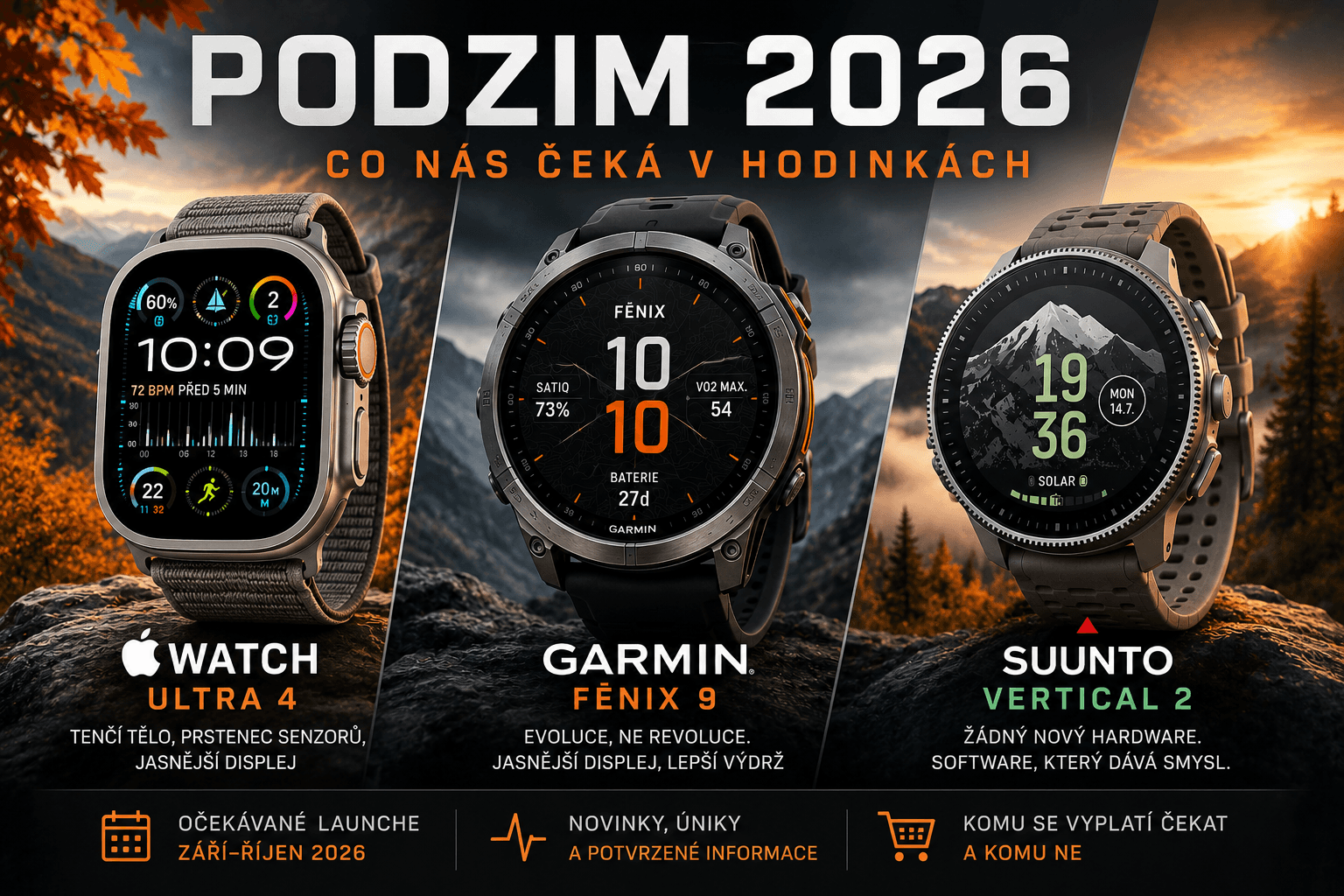
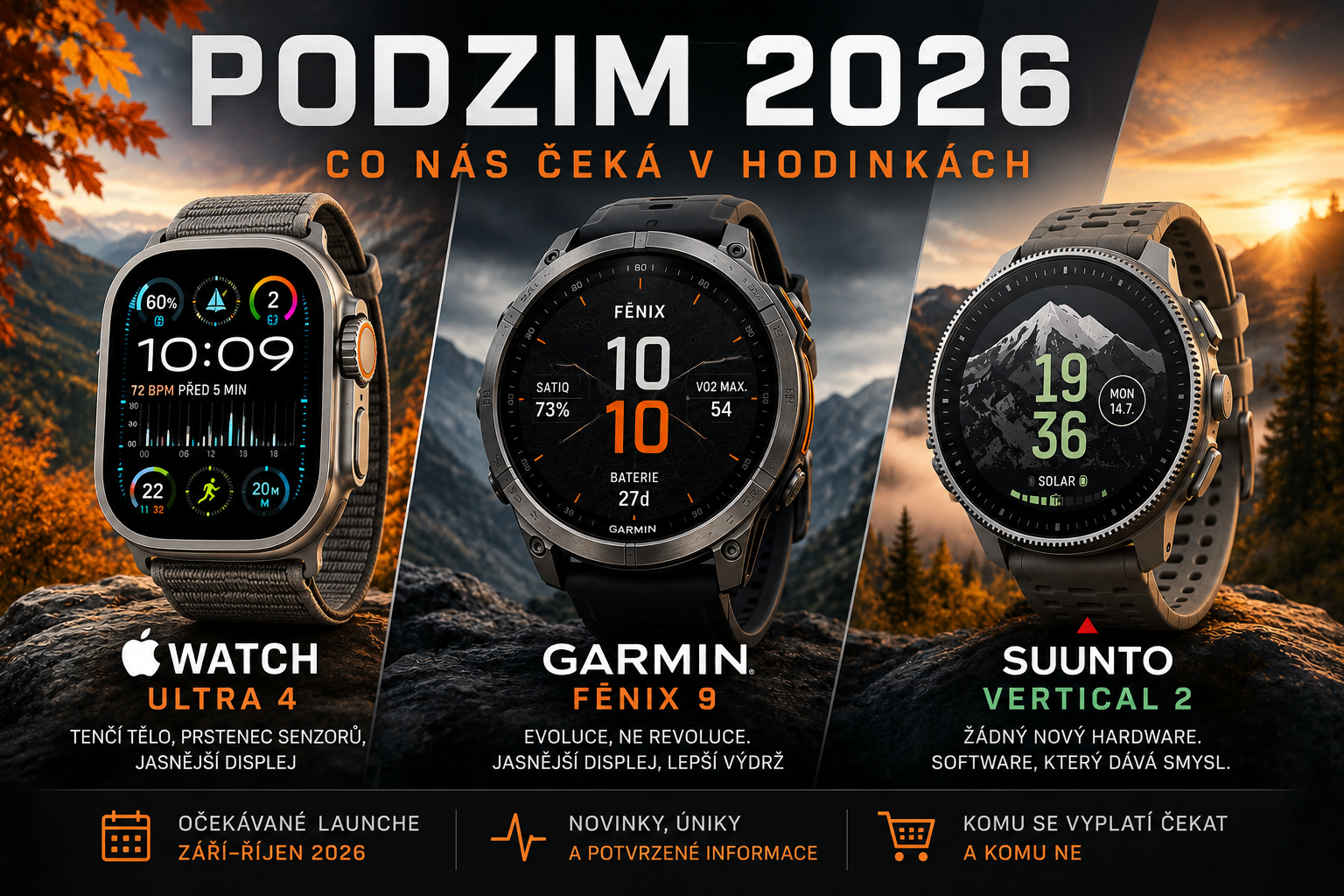
What to Expect from Watches in Fall 2026: Ultra 4, Fenix 9, and a Quiet Revolution at Suunto
What’s more interesting is the display. With the 51mm Pro, Garmin used a 1.5-inch panel with a resolution of 466 x 466 for the first time, without increasing the case diameter. Compared to the 1.4-inch display with a resolution of 454 x 454 found on both the Fenix 8 and the Fenix 8 Pro, this is a noticeable difference that really shows up on the map.
It’s classic Garmin. Offer as many options as possible and let the customer decide for themselves which compromise bothers them the least. This year, there are five basic configurations and over thirty models available. Clarity has never been this brand’s strong suit.
Endurance has improved, but let’s not expect a miracle
Garmin has traditionally highlighted battery life as one of its main selling points. The Fenix 9 brings improvements in this area, but it’s not a revolution. Battery life has improved, but it hasn’t gone to another galaxy.
And that’s actually okay. With modern watches, battery life isn’t determined by the battery alone. A large, bright AMOLED display, Always-on mode, satellite connectivity, LTE, and Pulse Ox can all take their toll on battery life. The Fenix 8 Pro demonstrated this very clearly, as its LTE and satellite hardware reduced the battery life compared to the standard Fenix 8—even though the numbers on the box looked good in watch mode.
What’s more interesting than the specs, then, is how consistently the watch performs in real-world use. And this is where we get to the Fenix 9’s biggest problem.
First Firmware, First Nerves
The hardware performs very well. The software, however, hasn’t been quite as reliable so far. Reports have appeared on Garmin’s official forum regarding issues with Wi-Fi, Garmin Express, updates, map rendering, the watch restarting, and heart rate monitoring. Some users report crashes during navigation, synchronization issues, or connection problems.
This should be taken with a grain of salt. People mainly visit forums when they have a problem, so this isn’t a statistically representative sample of all units sold, and individual cases may not indicate a systemic flaw. At the same time, it’s fair to point out that some of the issues may have causes other than the watch itself. In some cases involving Wi-Fi, network or DNS settings have been found to be the issue. Some of the reports regarding battery life, on the other hand, may be related to algorithm training and specific settings for the display, Pulse Ox, or Always-on mode.

However, some issues occur too frequently to be dismissed out of hand. Problems with map updates via Garmin Express are particularly frustrating. A watch that’s supposed to be a premium outdoor tool shouldn’t force its owner to wonder whether the problem lies with the watch, the computer, Garmin Express, the Wi-Fi, or the map data. That’s exactly when a technical issue becomes a user experience problem.
And here’s one more thing that reviews almost never mention. This isn’t the first time. The Fenix 8 had its share of problems after launch. The Fenix 8 Pro had its share of problems after launch. The Fenix 9 has its share of problems after launch. Three flagship generations in a row, three botched launches—each time for a product costing thirty thousand crowns or more. When something happens three times in a row, it stops being bad luck and starts becoming a business model. The customer pays a premium price to become a first-wave tester, and the reward is that in six months, they’ll have a watch that works the way it was supposed to from the start.
The Fenix 9 is therefore not a defective product. It’s very capable hardware whose software needs a few rounds of fine-tuning. I just wouldn’t call it a “teething problem” anymore, because teething problems don’t recur every year.
The third generation with the same sensor
And then there’s the feature that will be the most talked-about among Garmin fans: the sensors.
The Fenix 9 doesn’t feature a new-generation optical sensor. It retains the Elevate Gen 5—the same sensor found in the Fenix 8 Pro. The same sensor as in the Fenix 8. The same sensor that Garmin has been using since 2024 across its entire flagship lineup. Three generations of watches in a row, three press releases about progress, one and the same sensor.

For years, Garmin has proven that it can use software to extract a vast amount of data from existing hardware, and that’s where it truly excels. But when it comes to premium watches, the hardware itself is becoming increasingly important. While competitors measure skin temperature, blood pressure, or more advanced sleep metrics, Garmin instead adds another layer of software on top of data it collects in the same way it did two years ago.
A new sensor would be a simple and easy-to-sell reason why you really need the Fenix 9. Instead, we get faster maps, more memory, and a range of software features. These are good improvements, but they don’t sell as easily as the phrase “we have a new sensor that measures something we couldn’t measure before.”
So why hasn’t Garmin released the new sensor right now? Maybe it just isn’t ready yet. But there’s another possibility.
MARQ might be more interesting this year than it seems
Garmin has one very unique line in its product lineup: MARQ.
Logically, the most expensive watches should represent the pinnacle of technology. However, Garmin has so far based the MARQ on the hardware of an older generation of Fenix, complementing it with more luxurious materials, craftsmanship, and a significantly higher price. If the MARQ Gen 3 were to feature the new Elevate Gen 6 or more advanced health features, this year’s strategy would suddenly make much more sense. The Fenix 9 wouldn’t be the pinnacle of Garmin’s lineup this year, but rather its technological foundation. And the premium line would finally be more than just a more expensive version of existing technology, because it would be the first to receive the best that Garmin has developed that year. The MARQ’s high price would then be not just for titanium and sapphire glass, but also for its technological edge.
It’s worth noting that this is purely a hypothesis at this point, and Garmin hasn’t announced anything of the sort. However, I take it seriously because this exact scenario would explain why MicroLED disappeared from the Fenix and why the flagship outdoor model didn’t get a new sensor. Both features could be reserved for a higher-end series, where customers would pay even more for the new technology. If the MARQ does indeed launch with a new sensor, it will retroactively change how we view the entire Fenix 9—and, frankly, not in a very flattering way.
The 8 and 8 Pro will also receive the updates
And here’s one more detail that complicates things for the Fenix 9. Garmin is already showing that it doesn’t want to reserve a number of new features exclusively for the new model, and some of the software updates are also coming to the Fenix 8, Fenix 8 Pro, and other current devices. This is great news for users, but less so for the Fenix 9’s marketing. Garmin is selling watches that are faster and have more memory, but at the same time, it’s telling owners of previous generations that they won’t miss out on a large part of the new software experience.

It’s a customer-friendly approach, and it deserves praise. At the same time, however, it means something very specific. If you have a Fenix 8 Pro, you’ll get most of the new features for free—you already have satellite and LTE, the sensor is the same, and the display is even brighter on the MicroLED version. You’ll get a faster map, double the storage, an all-titanium case, and a slightly better display on the AMOLED models. It’s a nice list. It’s just not the kind of list that would make you buy a new watch for thirty thousand after only eleven months.
Prices in the Czech Republic: Good News for New Customers, Less So for Last Year’s Customers
I have to give Garmin credit here, because their prices in the Czech Republic have been a pleasant surprise this year.
The base Fenix 9, available in 43- and 47-mm sizes, is priced at 24,490 CZK, and that already includes sapphire crystal and a titanium bezel as standard features. According to Czech retailers, that’s roughly 500 Kč less than the steel version of the Fenix 8 with Gorilla Glass cost, and about 3,000 Kč less than a comparable sapphire-glass Fenix 8 did two years ago. The new generation is therefore nominally cheaper than the previous one, despite having twice as much storage and a better display. You really don’t see that very often with Garmin, and it’s only fair to say so out loud.

Garmin Fenix® 9 – 47 mm, Carbon DLC Black 010-04762-11
25 990 €
Premium multisport GPS smartwatch with 47mm carbon DLC black case, sapphire crystal and comprehensive sports and outdoor functions. Water resistant to 100M with heart rate monitoring, navigation and smart features.
The Pro versions with satellite connectivity start at 27,490 CZK, and the most fully-equipped models are priced around 32,000 CZK. Last year’s Fenix 8 Pro was launched at 29,990 Kč for the 47 mm model and 32,490 Kč for the 51 mm model. The new generation thus offers an all-titanium case, double the storage, and faster maps at the same or slightly lower price point.

Garmin Fenix® 9 – 47 mm, Carbon Grey DLC Titanium Black/Pebble 010-04336-16
28 490 €
Premium multisport GPS smartwatch with 47mm titanium case, sapphire crystal and comprehensive sports and outdoor features. Water resistance 100M, heart rate monitor, GPS navigation and smart functions.
From the perspective of someone who’s just buying a watch, this is clearly the best time in the last two years. From the perspective of someone who bought the Series 8 Pro last year, things look different. In the spring of 2026, Garmin slashed the prices of the entire 8 Pro series by 4,000 CZK, and in August, a new generation arrived that offers more for the same price. No one is saying that electronics shouldn’t get cheaper. But for a product marketed as a long-term investment, an 11-month product cycle is something other than a natural market evolution.

Garmin Fenix® 9 – 51 mm, Carbon Grey DLC Titanium Black/Pebble 010-04337-16
30 490 €
Premium multisport GPS smartwatch with 51mm titanium case, sapphire crystal and comprehensive sports and navigation features. Water resistant to 100M.
One little detail you won’t find in foreign reviews
This issue affects only Czech customers, which is why no one is writing about it.
Garmin used to include vouchers with previous generations of Fenix watches that allowed users to get detailed TOPO Czech V5 maps for free. These are no longer offered with the 9 and 9 Pro series, and Garmin has stopped distributing them. The watches still include global TOPO Active maps, as well as maps of golf courses and ski resorts. Anyone who wants the best available maps for hiking will need to subscribe to Outdoor Maps+.
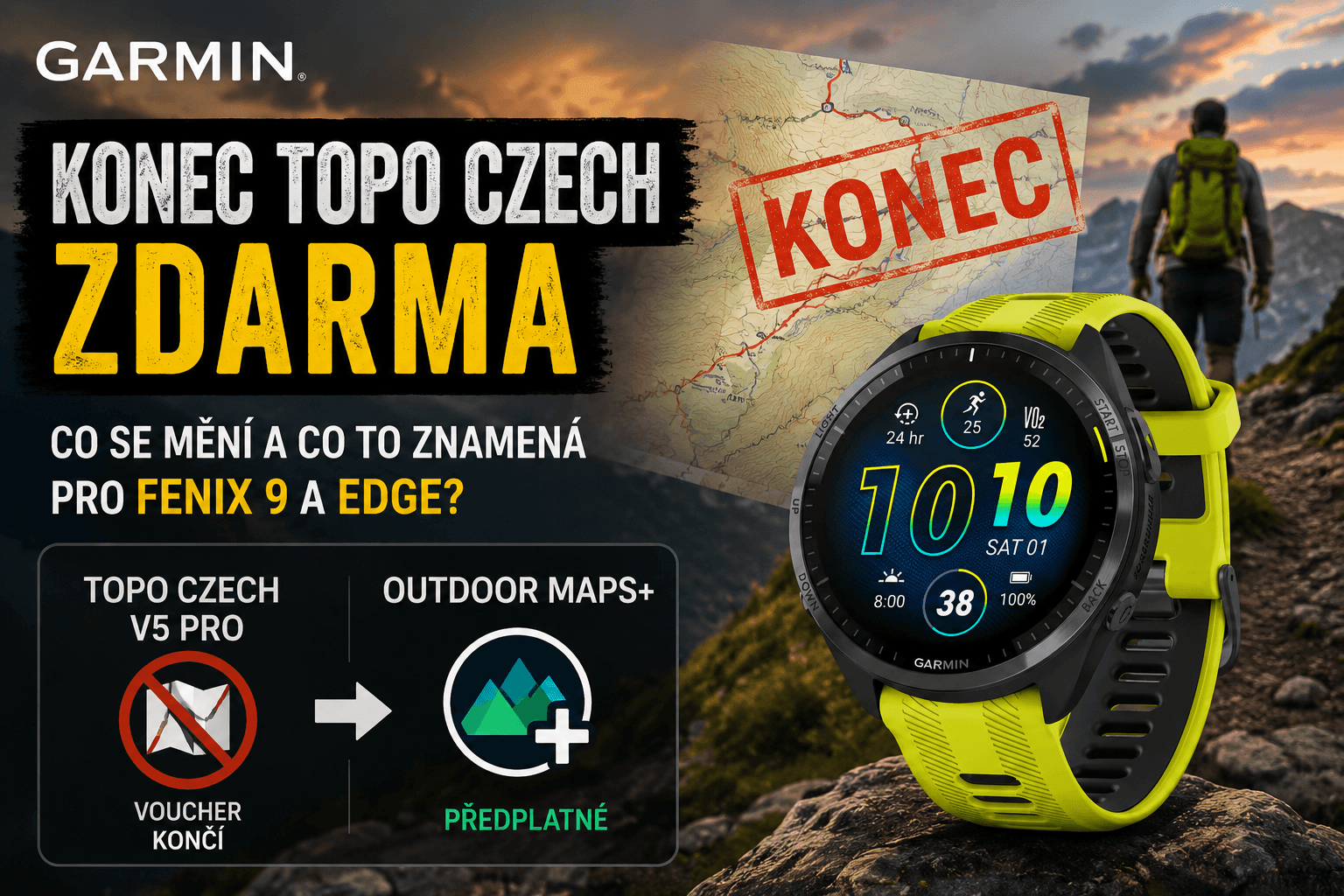
Garmin Is Ending Free Maps: The Timing with the Fenix 9 Is No Coincidence
For Czech tourists, this is a subtle but noticeable change. When you buy a watch whose main selling point is map functionality, you get a faster map engine and twice as much storage—but at the same time, you lose the map content that used to be included in the package. You’ll now have to pay extra for the maps you used to have, in the form of a subscription. It’s not a major reason not to buy the watch. However, it’s exactly the kind of information a Czech review should mention—and which, as a matter of principle, doesn’t make it into articles based on translations of foreign source material.
Who Should Buy the Fenix 9
If you’re buying your first premium Garmin watch, the Fenix 9 makes a lot of sense and is the best buy in the last two years. Improved mapping hardware, 64 GB of storage, an all-titanium case on the Pro series, satellite communication now available in the 43 mm model, and the return of solar-powered versions. The base Fenix 9 starts at 24,490 CZK in 43- and 47-mm sizes; the Pro versions with satellite communication start at 27,490 CZK, and the most expensive models are around 32,000 CZK. For the same price as last year, you get significantly more features.

Garmin Fenix® 9 – 43 mm, Gold Titanium Cream/Fog Grey 010-04335-26
30 490 €
Premium Garmin Fenix® 9 smartwatch with 43mm gold titanium case and sapphire crystal. Features GPS navigation, heart rate monitoring, and comprehensive sports functions. Water resistant to 100M with silicone strap.
If you have a Fenix 7 or an older model, the leap in technology is clear, and there’s no reason to hesitate.
If you have a Fenix 8 and your current watch doesn’t limit you in any significant way, there’s no reason to order a new model just because the number on the box has changed. Consider it if your Fenix 8 lacks satellite functionality or LTE, or if the slow map is annoying you.
If you have a Fenix 8 Pro, I think the answer is a clear no. Last year, you paid a premium price for the satellite and LTE capabilities you already have, for a sensor that hasn’t changed, and for a display that—in the MicroLED version—is still the brightest on the market. A faster map and double the storage are nice, but that’s not an upgrade—it’s just an extra cost. Wait for the next generation, which will feature a new sensor.
Verdict: A Garmin that isn’t quite ready yet
The Fenix 9 isn’t a bad Garmin. Quite the opposite. It’s probably one of the best outdoor models Garmin has ever made, and for a new customer, it’s the obvious choice. We just need to be clear about what that means—and what it doesn’t mean.
This means that Garmin has finally improved its mapping performance, storage capacity, and materials. It means that it has brought back a size and model that it discontinued last year. And it means that for the same price as last year, it’s offering a better watch. It doesn’t represent a generational leap. Compared to the Fenix 8 Pro—the model against which the Fenix 9 should truly be measured—it’s a solid evolution with the same sensor, the same satellite technology, a less clearly defined top-of-the-line model, and software that wasn’t quite up to par at launch.
The good news is that Garmin’s software is capable of gradually fixing issues, and it will likely manage to do so this time as well. In six months, the Fenix 9 could be exactly the model the manufacturer is promising today. But the question every customer should ask themselves is a different one: Do I want to pay a premium price just to wait six months for a finished product? And do I want to do that again every year?



Comments
No one has commented on this article yet. Be the first.