

 Jan Kobilka
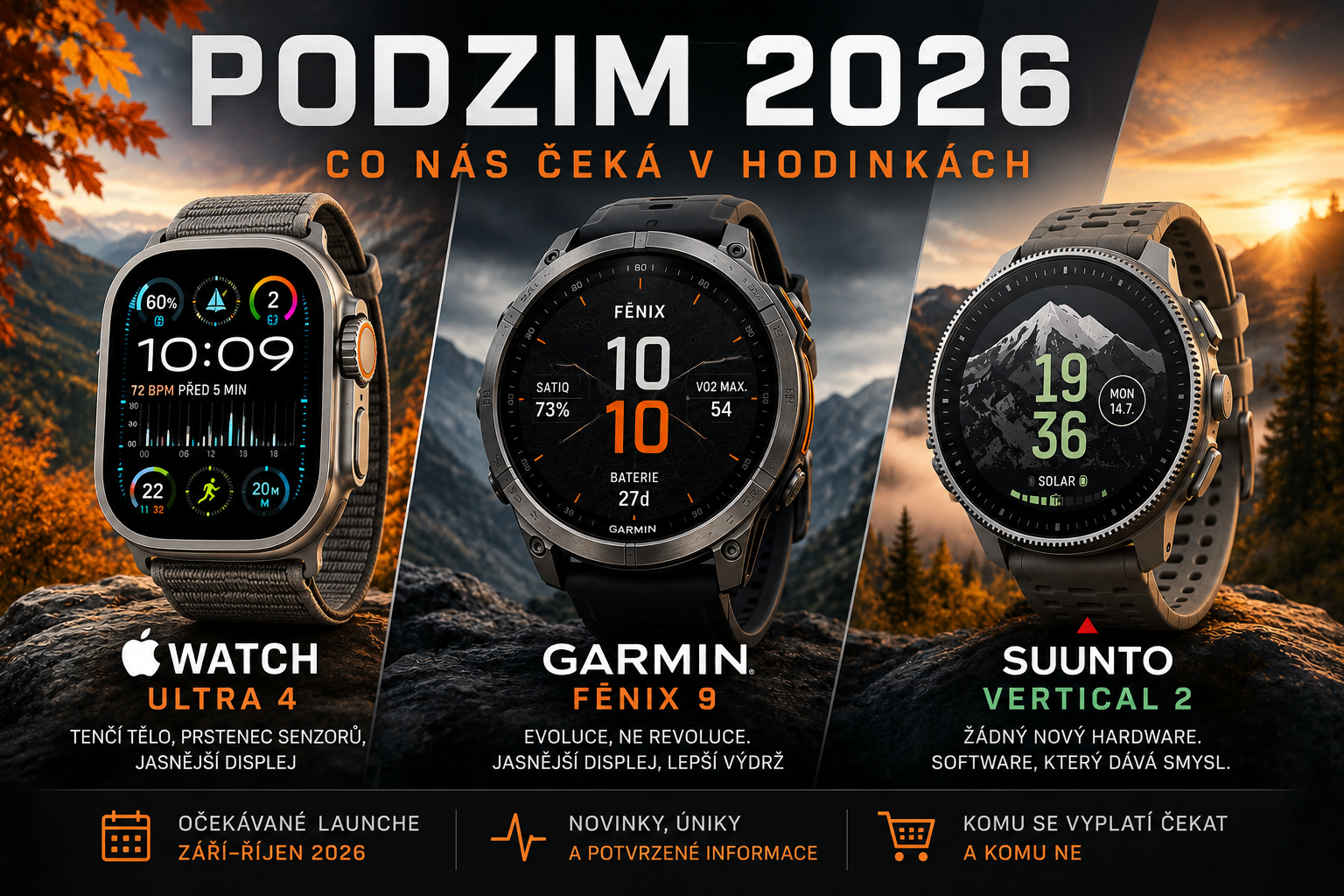
 The Apple Watch Ultra 4, Garmin Fenix 9, and Suunto Vertical 2 will be among the most anticipated sports watches of fall 2026. What do we know about them so far, when will they arrive, what new features will they offer, and who should wait for the next generation? Here’s an overview of confirmed information, reliable leaks, and practical advice on whether to buy now or wait until fall.
Table of Contents
- Zářijová shoda, která se možná zopakuje
- Apple Watch Ultra 4: tenčí tělo, prstenec senzorů a nejistý Touch ID
- Garmin Fenix 9: evoluce, ne revoluce a žaloba v pozadí
- Suunto Vertical 2: žádný nový hardware a přesto možná nejzajímavější update roku
- Tři hodinky, tři filozofie: srovnání dnešní generace
- Proč to každá firma dělá jinak
- Kdy se vyplatí upgrade a kdy raději počkat
- Mimochodem, hlídejte i tenhle týden
- Závěr
In a nutshell:
- Apple Watch Ultra 4 — expected in September 2026 alongside the iPhone 18. A thinner titanium case, a ring of sensors on the back, and Touch ID status uncertain.
- Garmin Fenix 9 — will likely be released between September and October 2026, but it will be more of a refined version of last year’s Fenix 8 Pro than a revolutionary new model. You’ll have to wait until 2027 for the Fenix 9 Pro.
- Suunto Vertical 2 — no new hardware is on the way. Instead, there are quarterly software updates, and the one from July 14, 2026, is the most substantial so far.
- In terms of price, Suunto remains the most affordable, Garmin the most expensive, and Apple falls somewhere in between—but with a completely different philosophy than both of those sports brands.
The September Agreement, Which May Be Repeated
Few people noticed, but all three current flagship models—the Apple Watch Ultra 3, the Garmin Fenix 8 Pro, and the Suunto Vertical 2—hit the market within three weeks at the end of summer 2025. Garmin was the first to launch on September 8, Apple followed on September 19, and Suunto’s Vertical 2 hit the market at the end of the same month. This coincidence isn’t entirely accidental: all three companies follow a similar annual cycle, and it’s quite possible that this pattern will repeat itself this fall, when successors from both Apple and Garmin are expected. Suunto is the exception this year, and that’s precisely why its story is the most interesting.
Apple Watch Ultra 4: A Thinner Case, a Ring of Sensors, and an Uncertain Touch ID
The Ultra 3 now features the largest and brightest display in Apple Watch history (LTPO3 OLED, rated at up to around 3,000 nits), a battery life of 42 hours of normal use (72 hours in power-saving mode), satellite SOS and messaging, 5G, high blood pressure trend alerts, and, new this year, a sleep score—all for the same price of 20,990 CZK.
According to reports from Digitimes, MacRumors, and other sources, the Ultra 4 is expected to arrive in September 2026 alongside the iPhone 18. While one source mentions the possibility of a delay until 2027, most leakers are sticking with this fall. The most frequently mentioned features are:
- A titanium body that's up to 15% thinner, slimmer bezels, and a redesigned (more compact) Action button.
- A ring of up to eight sensors on the back instead of today's flat disc; the goal is to reduce reliance on algorithmic data interpolation, resulting in more accurate measurements and longer battery life.
- A brighter display—we're talking up to 3,200 nits.
- The S11 chip, designed with efficiency in mind.
- Enhanced satellite and mobile features for emergency situations.
- Touch ID is a point of contention; some leakers are talking about a fingerprint sensor hidden in the crown or button (internal codename “AppleMesa”), while another, relatively influential source cited by MacRumors claims that Apple will prioritize battery capacity over biometrics this year and that Touch ID won’t be included.
- Blood pressure measurement should continue to become more accurate, but noninvasive blood glucose monitoring is (apparently) still several years away; the miniaturization of the sensor is reportedly not yet complete.
What can we expect in terms of price? At least in Europe, there’s talk of a price increase above the current level due to the new sensors and titanium case, but no one has dared to put an exact figure for the U.S. market yet. It’s also interesting that the standard Apple Watch lineup (Series 12) is expected to receive only a cosmetic update this year; a truly major redesign of the entire lineup is reportedly being postponed until 2027. People on forums are reacting to this with a healthy dose of irony: after all, there’s been talk of a “major redesign” of the Apple Watch pretty much every year for the past three or four years.
Pros that are emerging: more accurate sensors, a thinner and more comfortable body, and potentially longer battery life. Cons to watch out for: an uncertain price increase, Touch ID may not be included at all, and if the delay is confirmed, the entire release cycle will be pushed back by a year.
Garmin Fenix 9: An Evolution, Not a Revolution—and a Lawsuit in the Background
Just to be clear about what the Fenix 9 actually builds on: last year’s Fenix 8 Pro was the first Fenix ever to offer satellite and LTE connectivity via inReach—calls, messages, LiveTrack, and weather updates without a phone, as well as interactive SOS via satellite (Skylo network)—all for a subscription fee. The model with the AMOLED display (51 mm) has a brightness of around 2,000 nits and lasts up to 27 days in smartwatch mode. The version with a MicroLED display is a technological marvel—4,500 nits, 400,000 individual LEDs, and no screen burn-in—but at the cost of a drastic drop in battery life, down to just 4 days with the always-on display enabled.
According to Garmin CEO Cliff Pembel, the Fenix 9 is expected to arrive in the “active” second half of 2026—realistically sometime between September and October. What to expect:
- More of an improvement than a redesign—Garmin appears to be focused on making the technology from the Fenix 8 Pro (LTE, satellite, MicroLED) more streamlined, faster, and, above all, more battery-efficient, rather than adding fundamentally new features.
- A brighter AMOLED display—we're talking about up to 3,000 nits.
- Tri-band GNSS for more accurate positioning.
- A new, more energy-efficient chip.
- Gradual improvement in battery life.
- The price should be around the same as the Fenix 8.
- The Fenix 9 Pro isn't expected this year; Garmin is sticking to its established pattern, in which the Pro version is released a year later, so it makes more sense to wait until 2027 for it.
- In addition to the Fenix 9, traces of the Enduro 4 (the Fenix's endurance counterpart) have appeared in the Garmin Connect code, and there are also rumors about the MARQ Gen 3, Forerunner 170, and Vivosmart 6.
➡️ A behind-the-scenes detail worth mentioning: Garmin is currently embroiled in a very unpleasant legal dispute. In September 2025, Suunto (or rather, its Chinese owner, Dongguan Liesheng Electronic) sued Garmin over five patents—breathing rate measurement, golf swing recognition, and antenna design—claiming they apply to virtually the entire Fenix, Epix, Marq, Approach, Instinct, Venu, and Forerunner lines. In December 2025, Garmin responded with a 218-page counterclaim, arguing that it is Suunto, on the contrary, that is infringing on its patents for GPS hardware and physiological analytics. The first major hearing (the so-called Markman hearing) is scheduled for February 2027, with jury selection set for August 2027, so the dispute will drag on for quite some time, and the chances of an actual sales ban are historically low; most similar disputes end in a settlement. A parallel lawsuit filed by Strava ended similarly (it has since been withdrawn), and a separate ITC investigation is also underway regarding fall detection technology, which involves Garmin, Apple, and Samsung simultaneously. In other words, competition in this segment is playing out in the courts as well, not just on store shelves.
Pros that are emerging: a brighter display, more accurate GPS, and slightly fewer compromises on battery life when using the most advanced technologies. Cons to watch out for: anyone expecting a leap forward like the one from the Fenix 7 to the Fenix 8 Pro will likely be disappointed; this year looks more like a refinement than a revolution. And MicroLED will remain an expensive and power-hungry option for very few people.
Suunto Vertical 2: No New Hardware, Yet Perhaps the Most Interesting Update of the Year
Suunto isn’t playing the “new generation every year” game this year. Following the release of the Vertical 2 in late September 2025, there’s been no mention of a Vertical 3 at all; instead, there are regular, roughly quarterly software updates that are gradually closing the gap where Suunto has so far lagged behind Garmin, particularly in maps and navigation.
As a reminder of what the Vertical 2 already offers today: a 1.5″ AMOLED display with sapphire glass, dual-band GPS/GNSS (up to four satellite systems at once), a built-in LED flashlight, 115+ sport modes, and, most importantly, battery life that’s unmatched among AMOLED watches today—up to 65–66 hours in the most accurate GPS mode, up to 20 days in smartwatch mode, and up to 250 hours in power-saving expedition mode. All this at a price you won’t find anywhere else. However, it lacks a dive computer, a more extensive app store, wrist-based payments, or music storage, and the Suunto app remains much simpler than Garmin Connect.
And now, let’s talk about why even people who normally only follow Garmin or Apple are now talking about Suunto. Since the September launch, the updates have gone something like this:
- November 2025 — a minor update, mainly fixes and improvements.
- January 2026 — new sport modes (duathlon, swimrun, aquathlon), new data fields, and the ability to turn connected sensors on or off depending on the sport mode.
- April 2026 — Navigation taken to the next level: route retracing, contour lines, and labels in offline maps; zooming based on distance or elevation gain when navigating to a summit; and a customizable bottom bar with data.
- July 14, 2026 (version 2.56.18) — and here’s the big update: pairing via QR code, a new elevation-based training goal, new labels on offline maps (road names, bodies of water, peaks), a new tide widget, improved GPS accuracy, faster SuuntoPlus synchronization, and, most importantly, a jump in the number of routes you can save—from 15 to 200.
This latest update transforms Suunto from a “watch with good battery life” into a pretty serious navigation tool, without the user having to spend a single extra crown. On the Suunto community forum, users responded mostly with gratitude, praising especially the navigation improvements and the fact that long-requested details have finally been addressed (such as the watch now remembering heart rate transmission settings separately for each sport mode).
But there’s also a downside. Both this update and the April update were released only for the Vertical 2 and Race 2; older models—the Vertical 1, Race, and Race S—have received an increasingly meager share of updates in recent months (the Race and Race S received the April update but not the July one; Vertical 1 didn’t receive either of the last two). Owners of older models have been voicing their concerns quite loudly on the forum, and this is a sign that Suunto may be shifting toward a support model more akin to Garmin’s (newer model = longer support), which differs from its previous reputation as a brand that continued to provide firmware support even for fairly old watches.
The pros that are already here: the best price-to-battery-life ratio on the market, navigation is quickly catching up to Garmin, and there’s no reason to wait for new hardware.
Drawbacks you’ll encounter: a less robust app ecosystem, no payments or music on the watch, and if you own an older model, you might have to wait longer than before for new features.
Three Watches, Three Philosophies: A Comparison of Today’s Generation
| Apple Watch Ultra 3 | Garmin Fenix 8 Pro (AMOLED) | Suunto Vertical 2 | |
| Display | LTPO3 OLED, ~3,000 nits | AMOLED, ~2,000 nits (MicroLED version: 4,500 nits for $1,999) | 1.5″ AMOLED |
| Battery Life – Normal Use | 42 hours / 72 hours (power-saving mode) | up to 27 days (smartwatch mode) | up to 20 days (smartwatch mode) |
| Battery Life – The Most Accurate GPS | ~2:00 p.m. | dozens of hours, depending on the mode | up to 65–66 hours, 250 hours in power-saving mode |
| Satellite / Mobile Network | Satellite SOS and messaging (2 years free), 5G | inReach Satellite + LTE Calls/Messages (Pro only, subscription required) | None |
| Dive Computer | No (only WR100) | Yes | No (only WR100) |
| Offline Maps and Navigation | Yes, through third-party apps | Yes, TopoActive | Yes, you can now save up to 200 routes |
| Ecosystem | The Largest App Store, but Only on the iPhone | Garmin Connect IQ, the most in-depth sports analytics | Suunto app: the simplest option, with no payments and no music |
| Who Is It Best Suited For? | Everyday wear + occasional adventures | Elite Athletes and Expedition Users | Value for money, outdoor gear without breaking the bank |
The table shows that there are three different answers to the question “what should a watch do best?” Apple is banking on the idea that a watch is primarily a smartphone on your wrist with an outdoor twist. Garmin packs literally everything an athlete could want into a single device—and charges a hefty price for it. Suunto focuses on two or three things—battery life, navigation, and price—and leaves the rest aside.
Why Does Every Company Do It Differently?
At its core, Apple remains a “smartwatch-first” company. The Ultra series has earned an “outdoor reputation” mainly thanks to its satellite connectivity, larger battery, and durable design, but the heart of the product is still the iPhone, Apple Pay, Messages, and the App Store. Health features (blood pressure, sleep score, and eventually perhaps blood glucose monitoring) are a logical extension of Apple’s long-term health strategy and likely also a response to competitive pressure: Samsung has announced Galaxy Unpacked for July 22, 2026, where the Galaxy Watch Ultra 2 is expected to debut with a significantly more powerful Snapdragon Wear Elite chip. Furthermore, Apple’s target audience isn’t hardcore adventure athletes, but rather active everyday users who want one watch to do it all—which is why the emphasis is on comfort (possibly Touch ID) and AI assistance (Workout Buddy) rather than on the depth of sports metrics.

Garmin, on the other hand, targets precisely that hardcore core audience— elite athletes and expedition users, to whom it is willing to sell even technologically unique features like a MicroLED display—even though few people actually use it, and reviewers tend to describe it as a showcase of technology rather than a universally useful tool. At the same time, Garmin is facing mounting legal pressure (a lawsuit from Suunto, a previous lawsuit from Strava, and an ITC investigation regarding fall detection), which illustrates just how competitive and closely scrutinized the market for high-end sports watches is today. With the Fenix 9, we can expect the typical “consolidation, then expansion” pattern: first, make last year’s new models more affordable and efficient; only then add new features.

Suunto is playing a completely different game. Following its acquisition by the Chinese company Dongguan Liesheng Electronic, it’s shifting to a more affordable and agile model; instead of an expensive annual hardware cycle, it’s extending the lifespan of a single generation of watches through frequent, free software updates. The fact that there’s no new Vertical this year is no coincidence, but apparently a conscious choice: why develop a new chip and display when software updates can bring the maps and navigation up to speed while remaining hundreds of dollars cheaper than Garmin? However, the price to pay is clear: no satellite, no microLED, and, more recently, narrower support for older models—which may eventually damage the reputation of a brand that used to be known precisely for supporting its watches with firmware updates long after launch.

When Is It Worth Upgrading, and When Is It Better to Wait?
- Do you have an Ultra 2 or an older model? The Ultra 3 is a solid buy right now and is often on sale, since the Ultra 4’s price and exact release date are still uncertain. If you don’t need the very latest sensors, feel free to buy it now.
- Do you have an Ultra 3? Hold on. The changes described (a thinner body, more sensors) are nice, but they don't represent a major leap forward, and neither Touch ID nor the exact price is certain.
- Do you have a Fenix 7 or an older model and want satellite and LTE? The Fenix 8 Pro offers these features today—there's no point in waiting for the Fenix 9 if you need these features right away.
- Do you have a Fenix 8 (or 8 Pro)? It looks like the Fenix 9 will mainly be about refinements—a thinner, slightly brighter display, and better efficiency. If you don't need one right away, you can easily wait until fall, but it probably won't be a huge difference.
- Are you thinking about buying your first serious outdoor watch and watching your budget? The Suunto Vertical 2, following its July update, is an exceptionally good deal right now—there’s no new hardware on the horizon, so there’s no reason to wait.
- Do you have a Vertical 1, Race, or Race S? It's a bit more complicated here—new features are rolling out to you more slowly than to Vertical 2/Race 2 owners. If having the latest firmware is important to you, switching to the Vertical 2 makes sense right now.
- Do you want the absolute best display, regardless of price? The MicroLED version of the Fenix 8 Pro is already available; there’s no point in waiting for the Fenix 9 just for that. Instead, keep an eye on whether Garmin will fix the current noticeable drop in battery life by fall.
By the way, keep an eye out this week, too
This doesn’t directly concern the Apple/Garmin/Suunto trio, but it’s worth mentioning: Samsung has a Galaxy Unpacked event scheduled for July 22, 2026, in London, where, in addition to foldables, we can expect the Galaxy Watch Ultra 2 with a new Snapdragon Wear Elite chip and the promised significantly longer battery life compared to the first Ultra. For Android users, this may be more interesting news this year than anything from Apple, and it indirectly shows why Apple can’t put off the Ultra 4 redesign indefinitely.
Conclusion
There are two reasons why this fall will be worth watching. First, Apple and Garmin will once again be on nearly the same starting line, and it will be interesting to see which of them makes the bigger leap. Second, Suunto is showing that to keep a watch relevant, you don’t have to change the hardware every year—all it takes is a solid software update plan and a willingness to listen to your own community.
For buyers, this ultimately boils down to one simple piece of advice: if you’re in no rush, it’s worth waiting for Apple and Garmin this fall; if you want to buy now and aren’t concerned with the latest trends, the Suunto Vertical 2—following its July update—is likely the best value for the money on the market.


Comments
No one has commented on this article yet. Be the first.