

 Jan Kobilka
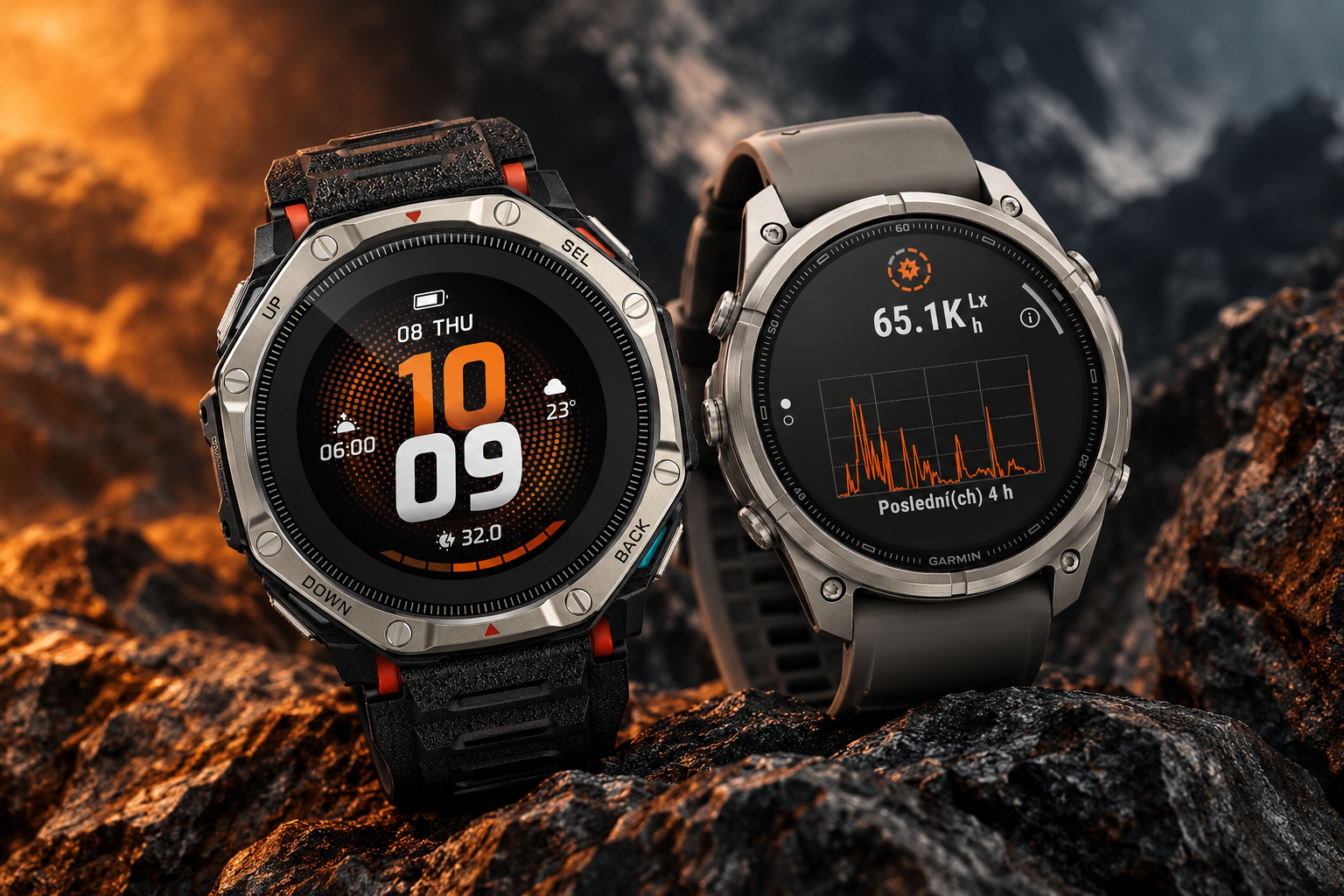
 The Amazfit T-Rex Dual Solar offers an unusual combination of an AMOLED display and solar charging, while the Garmin Fenix 9 Pro Solar relies on a tried-and-true MIP display and passive solar charging. Which approach works better in practice? We compared the display, battery life, solar charging, build quality, GPS, and smart features of both outdoor watches.
For years, we’ve been saying it over beers, on forums, and in the newsroom: “If only the Fenix had an AMOLED display and solar charging.” Garmin tried to get around it, experimented with MicroLED, and ultimately always came back to the same conclusion: it’s not possible; it doesn’t make sense. And then along comes Amazfit and puts a watch on the table that simply pulled it off. Is it a revolution, or just a very expensive technological experiment? We took it apart down to the last screw.
Table of Contents
A Dream That Was Meant to Remain a Dream
If you’ve been following sports watches for more than a few seasons, you know this story by heart. Garmin built the Fenix series’ reputation on two pillars: brutal battery life and indestructibility. For a long time, the transflective MIP (memory-in-pixel) display helped it maintain both of these qualities. The display itself doesn’t emit light but reflects ambient light, so it consumes only a fraction of the energy, and the image remains visible at all times without the need to turn on the backlight. And because it transmits light, a solar cell could be hidden beneath or around it. This led to the creation of the Fenix 6 Solar, Fenix 7 Solar, and Instinct Solar generations—and an entire family of watches that, with a little luck in the mountains, you practically never have to charge. The trade-off was a display that resembled e-ink more than the screen of a modern device: low resolution, a limited color palette, and washed-out contrast.
Then came 2022 and the second-generation Epix. AMOLED in the Fenix—or rather, in its twin. Colors, contrast, maps that finally looked like maps—and not like a gray-blue sketch from 2008. People fell in love with it, and from that moment on, the same debate raged across all forums: either a beautiful display or solar charging. Not both at once.
The Fenix 8 just cemented this schizophrenia. The lineup included an AMOLED model and, alongside it, a separate Solar version with MIP. The Fenix 8 Pro then introduced MicroLED—the brightest display ever seen on a watch—but with a price, thickness, and battery life that made it more of a technological flagship than a practical choice. Meanwhile, Garmin repeated its mantra: in its view, combining AMOLED and solar technology doesn’t make sense from an energy standpoint, and the space inside the case is better used for a larger battery.
And now, in September 2026, we have the Amazfit T-Rex Dual Solar. A brand that many Fenix fans still dismiss as “those cheap Chinese watches,” and which is delivering exactly what Garmin called nonsense: AMOLED. Solar. And not just one panel, but two.
First, the physics: why AMOLED and solar panels don’t go together
Before we get into the comparison, it’s important to understand why Garmin resisted this for so long. It’s not about marketing, but about physics—and that’s the crux of the matter.
From the perspective of a solar cell, a MIP display is nearly the ideal neighbor. It is transflective—meaning it partially transmits light—and consumes so little energy itself that even a small amount of energy gained from the sun makes a noticeable difference in the overall balance. Garmin was therefore able to incorporate a photovoltaic layer both into the ring around the display and directly beneath the glass (in more expensive versions, under the name Power Sapphire). Light passes through, the cell captures it, and the display continues to function.
AMOLED is a completely different beast. It’s emissive—each pixel glows on its own. The entire display assembly is essentially an opaque sandwich: organic layers, a transistor layer, a polarizer, and a touch layer. The polarizer alone absorbs about half of the incident light. If you wanted to place a solar cell “under” the AMOLED, it would only get the leftover light. That leaves the area around the display—a ring—or possibly some form of translucent layer above the panel, which, however, inevitably reduces brightness and contrast.


The second issue is power consumption. AMOLED with the always-on mode enabled consumes an order of magnitude more power than MIP. A solar cell measuring just a few square centimeters on the wrist—which, moreover, is hidden under a sleeve for most of the day—simply has no chance of meaningfully covering that level of power consumption.
Let’s do a quick calculation, because that’s what we like to do. Sunlight with an intensity of 50,000 lux (that’s the lab standard used by both Garmin and Amazfit) corresponds to roughly 400 W/m², or about 40 mW per square centimeter. Due to transparent layers, angles of incidence, and design compromises, the solar cell in the watch has a real-world efficiency measured in percentages. Let’s be optimistic and say 5%. That means you’ll get about 2 mW from each square centimeter. The Amazfit’s battery has a capacity of 660 mAh, or roughly 2.5 Wh. If the watch lasts 25 days, it consumes about 100 mWh per day. For the solar panel to double the battery life, it would have to supply approximately 50 mWh per day, which—with three hours of sunlight—means a constant power input of around 17 mW. This corresponds to an active surface area of roughly 8 to 9 cm² in direct sunlight and at an ideal angle.
And now for the key point: you simply won’t find a surface like this on the front of a 51-mm watch, where the display takes up most of the space. You will on the back, though. But the back is pressed against your skin on your wrist. This brings us to what Amazfit did differently—and why it’s both ingenious and, in a way, a bit of a stretch of common sense.
Amazfit T-Rex Dual Solar Under the Microscope
Two panels, two philosophies
Amazfit elegantly overcomes this physical limitation: when there isn’t enough space on the front, it makes use of the space on the back. The brand is presenting the watch as the first AMOLED watch with dual-sided solar charging. The front collects energy in the display area, while the back uses a glass-ceramic panel whose active surface area, according to Amazfit, is more than double that of the front.
It’s worth mentioning a minor inconsistency in the manufacturer’s communication here. The Czech product description states that the watch captures energy through both the AMOLED display and the back cover, while the technical specifications on the same page indicate that there are two solar panels: a ring around the display and the back cover. For users, the difference is mostly academic, but for technical enthusiasts, this is important information: it’s likely not a photovoltaic cell directly beneath the AMOLED layer, but rather a cell located around the display. This makes physical sense and aligns with what we described above.

A key detail that’s easy to overlook in marketing: both surfaces don’t charge at the same time. When sunlight hits the back panel, the watch may enter Solar Boost mode, which locks the rest of the interface until you exit it. In other words, the back panel is designed for situations when you’re not wearing the watch. You take it off during a break, place it face-down on a rock, or clip it to your backpack strap with the back facing the sun. Amazfit openly states this itself: Solar Boost mode uses the back panel for efficient charging during breaks, while Outdoor Extreme mode minimizes power consumption and retains only key outdoor functions.
This is a fundamental paradigm shift. Garmin Solar is a passive system: you wear the watch, you’re outdoors, and it recharges itself a little bit. The Amazfit Dual Solar is largely an active system: you have to pay attention to the watch and consciously “expose” it to sunlight. It’s more like a small solar charger built into the watch than a classic Fenix solar watch.
Hardware and Compromises
The Dual Solar is essentially a twin of the T-Rex Ultra 2, but the solar panel has taken its toll. The display has a diagonal of 1.32 inches, a resolution of 466 × 466, and a brightness of up to 3,000 nits under sapphire glass. The battery has a capacity of 660 mAh, compared to the Ultra 2’s 870 mAh and 1.5-inch display. The case measures 51.4 mm wide and 16.9 mm tall, including the heart rate sensor, and the body itself weighs 69 g.

Let’s take a closer look at that number, because it’s the most important technical specification of the entire product. Because of the solar panels, Amazfit had to reduce the battery capacity by a quarter and the display size by more than 10% of the diagonal. So the solar panels first took away energy (smaller battery) so they could then give it back. This is exactly the trade-off Garmin is referring to when it argues that the space is better used for a larger battery.
In terms of construction, this is a solid outdoor watch. The bezel and buttons are made of Grade 5 titanium, the middle case is made of polymer, and the caseback combines titanium with glass-ceramic. The strap is 26 mm wide, which is standard for outdoor watches designed for larger wrists. The watch is water-resistant to 10 ATM, supporting recreational diving to 50 meters, and features a flashlight with white and red light modes, dual-band GPS, pre-installed maps, route planning, and over 180 sport modes. It also includes a microphone, speaker, and Bluetooth calling, a low-temperature mode down to minus 30 °C, and a side charger—though this charger does not use the same connector as other current Amazfit watches.


➡️ A quick note for careful readers: on the manufacturer’s Czech website, one paragraph mentions support for diving to 50 meters, while a paragraph a little further down mentions 100 meters. International sources all list 50 meters; I would also go with that figure.
Among the smart features, payments are worth mentioning. Zepp Pay lets you add up to eight cards and works through the Curve service and participating banks in 31 countries, including the Czech Republic. This is convenient, but it’s good to know that it’s not a direct integration with your bank, but rather an intermediary layer provided by Curve. For some, this is a minor detail; for others, it’s a cause for concern.
Training is based on the Zepp platform, which features HybridCharge, BioCharge, and LifeLoad metrics. HybridCharge Energy Intelligence combines training load, BioCharge, and LifeLoad to show how training, recovery, sleep, and daily activities affect performance over time. It also supports the connection of external heart rate straps, the Stryd footpod, and action camera controls—a significant step for Amazfit toward becoming a “mature” sports platform.
And the price? On the manufacturer’s Czech website, it costs 16,449 CZK, including VAT. In the U.S., it costs $649.99, which is $100 more than the T-Rex Ultra 2.
Official endurance figures
Amazfit lists the following figures on its Czech website: up to 25 days with normal use, up to 13 days with heavy use, up to 51 days with normal use and solar charging, and up to 18 days with heavy use and solar charging. In precise GPS mode, the watch lasts up to 41 hours.

What’s more interesting, however, is the breakdown that Amazfit published in its comparison: normal use plus three hours of front solar charging yields up to 34 days, while normal use plus three hours of rear solar charging yields up to 51 days. The solar figures are based on three hours of sunlight at an intensity of 50,000 lux.
Here it is, in black and white. According to the manufacturer, the front panel—the one that’s active when you’re wearing the watch—extends the battery life from 25 to 34 days. Those magical 51 days apply to the back panel, which, by design, doesn’t work when the watch is on your wrist. That means taking the watch off for three hours a day and exposing the back to direct sunlight. Honestly: who does that every day?
Garmin Fenix 9 Pro Solar 51 mm: A Solid Workhorse with MIP
Garmin has remained true to its roots
The Fenix 9 series has introduced a number of changes. The Fenix 9 series has thirteen models across five lines, and the solar-powered variant has been moved to the Pro series. While the Fenix 8 was a standalone model without Pro features, the Fenix 9 is available only as a Pro model—and also comes in a version with an LTE modem and satellite connectivity.

Key information for our comparison: The Fenix 9 Pro is available in AMOLED and MIP Solar versions in 47-mm and 51-mm sizes, all running the same software. Since the Amazfit has a diameter of 51.4 mm, we’re comparing it fairly to the 51 mm version of the Fenix—that is, watches in the same size category. The solar version is thicker and has a smaller display than its AMOLED counterpart. For the 51mm version, the thickness is 15.8 mm for the AMOLED model versus 16.6 mm for the MIP Solar model—roughly 5% thicker. The difference here is significantly smaller than with the 47mm models, where the solar version adds a full two millimeters. The AMOLED display on the 51mm version measures 1.5 inches with a resolution of 466 × 466 pixels—the largest AMOLED display in Fenix history—while the MIP Solar measures 1.4 inches with a resolution of 280 × 280 pixels.
So in 2026, Garmin responded to fans’ wishes just as it always has: if you want solar charging, you’ll get MIP. If you want AMOLED, don’t expect solar charging. Part of the Czech community views this rather positively: there was frequent speculation about whether Garmin would keep the transflective MIP with solar charging on the Fenix, and it’s good that they did—even though, with the improving quality of AMOLED displays, the Solar version now makes sense only for a specific group of users.
Titanium, a Flashlight, and Phoenix DNA
The Fenix 9 Pro introduced a historic first. It is the first Fenix with a titanium case, which—thanks to nano-molding technology—combines metal and plastic at the molecular level, reducing the overall thickness while keeping the weight low. The 51mm version of the Fenix 9 Pro Solar—the one we’re comparing here—weighs 77 g (the smaller 47mm version weighs 63 g).

The flashlight has received an upgrade that anyone who has ever returned from the mountains after dark will appreciate. The Fenix 9 Pro is the first to offer a flashlight with white, red, and green light, while the base Fenix 9 has standard white and red light. Previously, only owners of military-grade Tactix models were familiar with the green light. Amazfit offers white and red.
Battery life: Garmin is in a league of its own here
This shows why Garmin isn’t abandoning MIP. The following figures apply to the 51mm Fenix 9 Pro Solar: smartwatch mode up to 30 days (57 with solar charging), power-saving mode up to 52 days (291 with solar charging), regular activity up to 75 hours (124 with solar), activity with music up to 21 hours (23 with solar), activity with LiveTrack via LTE up to 30 hours (35 with solar), maximum GPS battery life up to 186 hours (1,000 with solar charging), maximum accuracy up to 54 hours (75 with solar charging), and expedition mode up to 42 days (124 with solar charging). One thousand hours of GPS recording—that is, over 41 days of continuous tracking—is a figure that is unparalleled in the current world of sports watches.
➡️ Important methodological note: Garmin calculates solar values based on wearing the device all day and spending three hours outdoors at 50,000 lux.
Notice the phrasing “when worn all day.” Garmin assumes the solar panel operates on the wrist. Amazfit, in its top-of-the-line model, assumes the solar panel operates away from the wrist. It’s like comparing apples and oranges.
Price
The 51mm Garmin Fenix 9 Pro Solar costs 29,490 Kč, and 31,990 Kč with inReach (the smaller 47mm version costs 27,490 Kč, and 29,490 Kč with inReach). The price difference compared to the Amazfit is therefore roughly 13,000 Kč, and over 15,500 Kč for the version with inReach. That’s no small amount—it’s enough to buy another decent sports watch.
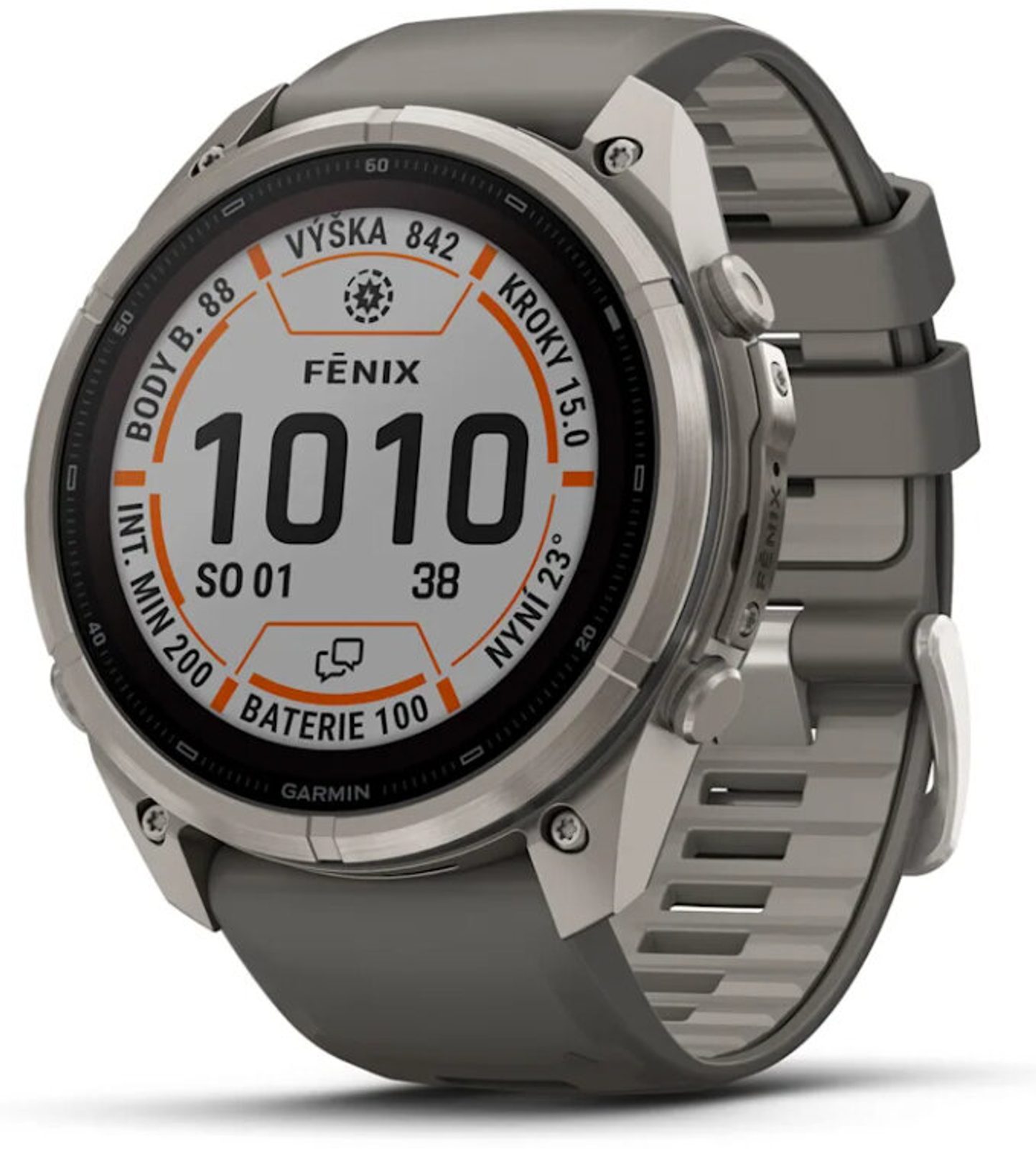
Garmin Fenix® 9 – 51 mm, Titanium Pebble Grey/Silver Grey 010-04339-01
31 990 €
Accept the Next Challenge Premium multisport GPS watch in an all-titanium case with solar charging display. Built for athletes who train at full intensity and for those who spend days in the field far from civilisation. Features advanced stamina and endurance tracking, integrated LED torch and inReach technology with
Duel: Point by Point
Display: Amazfit wins hands down here
There’s no point in beating around the bush. AMOLED with a resolution of 466 × 466 versus MIP with a resolution of 280 × 280 is a battle between two generations. Interestingly, the Fenix’s display is actually slightly larger (1.4 inches vs. 1.32 inches), but it packs roughly 78,000 pixels into that space, while the Amazfit has over 217,000—nearly three times as many. In terms of pixel density, that translates to roughly 353 pixels per inch for the Amazfit versus approximately 200 for the Fenix Solar. On the Amazfit, you’ll see sharp font edges, fine contour lines, and small labels on maps that either blur together on the MIP or aren’t rendered at all for readability.

The difference is even more pronounced when it comes to colors. Garmin’s MIP display uses a very limited palette—roughly in the range of tens of colors—and those colors appear more pastel-like and faded. AMOLED displays the full color spectrum with rich hues and true black, because a pixel that isn’t lit is simply turned off. Maps finally look like maps: forests are green, water is blue, contour lines are legible, and the highlighted route stands out clearly against the background. The same goes for heart rate, zone, and elevation graphs, which are easy to read at a glance on AMOLED, whereas on MIP you often have to “decipher” them.
Furthermore, the frequently repeated argument that MIP is more readable in direct sunlight should be taken with a grain of salt. In reality, the watch’s readability in direct sunlight depends largely on the crystal: its anti-reflective coating, the amount of glare, and the distance between the crystal and the display panel itself. Both competitors feature sapphire glass, so the decisive difference between them lies not in readability, but in how detailed and color-rich the display’s image is. And in this regard, AMOLED is unrivaled.
Garmin itself, in fact, hinted at where the industry is headed when explaining why the Fenix 9 Pro omitted MicroLED: according to the company, the new AMOLED display with 3,000 nits of brightness is sufficient. DC Rainmaker, who wore the MicroLED version of the Fenix 8 Pro for a year, said that in the bright Mediterranean sun, he didn’t notice any real difference compared to the Fenix 9. And the Amazfit has the same 3,000 nits.
So the MIP’s only real selling point remains fuel economy. And that brings us to the next category.
Solar: The Lab Versus Reality
This is the most important part of the entire article, and it deserves our full attention. The first serious review of the Amazfit T-Rex Dual Solar was published by Ray Maker of DC Rainmaker, and his findings are significantly more down-to-earth than the marketing claims.
When worn on the wrist and exposed to sunlight all day, the battery charge increased by about 2 to 3 percent. One day, between 9:45 a.m. and 3:15 p.m., the battery charge went from 53 percent to 55 percent. Two percentage points in five and a half hours in the sun. Let’s face it, that’s not much.
Even more interesting is a problem you don’t see in the lab: heat. The back panel is a major energy collector, but it also gets very hot. At temperatures around 27 to 32 °C, according to Maker, it overheated in about 10 minutes and then stopped charging until it cooled down. Amazfit told him that it should work better in cooler Alpine conditions.
That makes physical sense. A dark glass-ceramic panel in direct sunlight acts as a small heat collector, and lithium batteries don’t like being charged at high temperatures. The firmware therefore logically disconnects it. Paradoxically, the very sunlight you’d most like to take advantage of may be rejected by the system itself.

It doesn’t look much better on the wrist during activity. A 1-hour-and-20-minute night bike ride drained the battery from 45% to 42%, or about 2% per hour without solar charging. A one-hour run in the sun went from 43% to 41%, also about 2% per hour. A 2-hour, 12-minute ride in the sun went from 51% to 46%, and the watch showed zero solar gain during the activity. Amazfit is investigating this; one theory is that the watch selected the back panel while it was pressed against the wrist.
The latter is either a software bug or a design flaw, and in either case, it’s good to be aware of it. If it’s a panel selection error, it can be fixed with an update. If it’s a limitation of the front panel, then you can’t really rely on it.
To be fair, it’s worth mentioning the positives as well. Maker confirmed that the watch can start up from zero using solar power alone. He also noted that Amazfit’s solar widget is clearer than Garmin’s: it separates front and rear solar gains and shows the number of days’ worth of power gained in smartwatch, power-saving, and time-only modes. However, it does not account for the energy the watch consumes at the same time.
That ability to start up from zero is, by the way, truly valuable in extreme situations. If your watch runs out of battery completely during a multi-day trip, you can “revive” it in the sun just enough to check your location or navigate to a cabin. The Garmin Solar MIP, with its significantly lower power consumption, can also do this in practice, but this is a new feature for AMOLED watches.
Garmin Is Ending Free Maps: The Timing with the Fenix 9 Is No Coincidence
The overall conclusion of the test is clear: Amazfit had to reduce the size of both the battery and the display to accommodate the solar hardware, and the actual benefit when worn on the wrist is minimal.
And Garmin? According to official figures, the Fenix 9 Pro Solar 51 mm’s solar battery life in smartwatch mode increases from 30 to 57 days—an increase of nearly 90%. A larger case also means a larger solar surface area, and that’s reflected in the numbers. Even so, these figures are based on lab tests, and you won’t achieve them during the Czech fall or winter. But MIP plus solar is a system refined over five generations of watches, and its power gain happens passively, right on your wrist, without modes that lock the interface. The difference between “solar charging works without you even knowing it” and “solar charging works when you pay attention to it” is enormous in practice.
Battery and Battery Life: The Reality Without Solar Power
Let’s forget about the sun for a moment and focus on what you can always count on.
In normal smartwatch mode, the Amazfit offers 25 days of battery life, while the Fenix 9 Pro Solar 51 mm offers 30 days. On paper, then, Garmin comes out on top—even without a single ray of sunlight. However, it’s important to note that manufacturers measure “typical use” differently, with varying display settings, notifications, and tracking options. A direct comparison of these figures is always just a rough guide.


It’s more interesting when it comes to GPS. Amazfit promises 41 hours in precise GPS mode, while Fenix promises 54 hours in maximum accuracy mode (75 hours with solar charging). Here, Garmin leads by about a third, which—given the virtually identical case size—shows just how much energy MIP saves and how much space Garmin can dedicate to the battery. For the Amazfit, with its smaller battery and AMOLED display, 41 hours is still a decent result, reflecting good chipset optimization, but it’s not enough to beat Garmin in this head-to-head comparison.
Where Garmin falls short is in its power-saving and expedition modes. 186 hours in maximum GPS endurance mode, 42 days in expedition mode, and with solar charging, figures that run into the hundreds or even thousands of hours. While Amazfit offers its own Outdoor Extreme mode, it hasn’t published comparable official figures with similar levels of detail. For ultramarathoners, participants in multi-day races like the Tor des Géants, or people setting out on week-long treks without electricity, the MIP remains unbeatable.
Construction and Wear
This is where it starts to get interesting. When comparing the 51mm versions, the two competitors are very similar in size: the Amazfit measures 51.4 mm in diameter and 16.9 mm in height (including the sensor), while the Fenix measures 51 mm and 16.6 mm. The weight differs more significantly: the Amazfit’s case alone weighs 69 g, while the Fenix weighs 77 g. You’ll really notice those eight grams on your wrist while sleeping and running, when the heavier watch “bobs” more. On a large wrist, both models will look like typical outdoor “tanks”; for a slimmer wrist, the 47-mm version of the Garmin is the more sensible choice, while the Amazfit isn’t available in a smaller size.

In terms of materials, Garmin has the edge, as the Fenix 9 Pro is made entirely of titanium with nano-molding, while the Amazfit combines a titanium bezel and buttons with a polymer middle frame. In terms of durability, this isn’t a dramatic difference—polymer bezels are common in outdoor watches and can withstand a lot of wear and tear. However, when it comes to how it feels in the hand and its premium feel, Garmin clearly comes out on top.
Both have sapphire glass, both have a flashlight (Garmin with three colors, Amazfit with two), and both are water-resistant enough for swimming and recreational diving.
There’s one thing I’d point out as a negative with Amazfit: the new, incompatible charging connector. If you have other Amazfit devices at home, their cables won’t work. For a watch designed for adventures, where every extra cable is a burden, this is an unnecessary complication.
Software and Ecosystem: The Real Price Difference
If it were just about the hardware, the comparison would be much closer. But with watches that cost tens of thousands, what you’re really buying is the platform.
Garmin Connect, Connect IQ, Training Readiness, HRV status, precise training plans, a huge community, integration with Strava, TrainingPeaks, Komoot, and dozens of other services, third-party apps, hundreds of watch faces, and data fields for activities. In addition, Pro models offer the optional inReach feature with satellite communication and emergency SOS via the 24/7 Garmin Response coordination center. All of this is the result of fifteen years of development and is the main reason why people pay a premium for the Fenix.
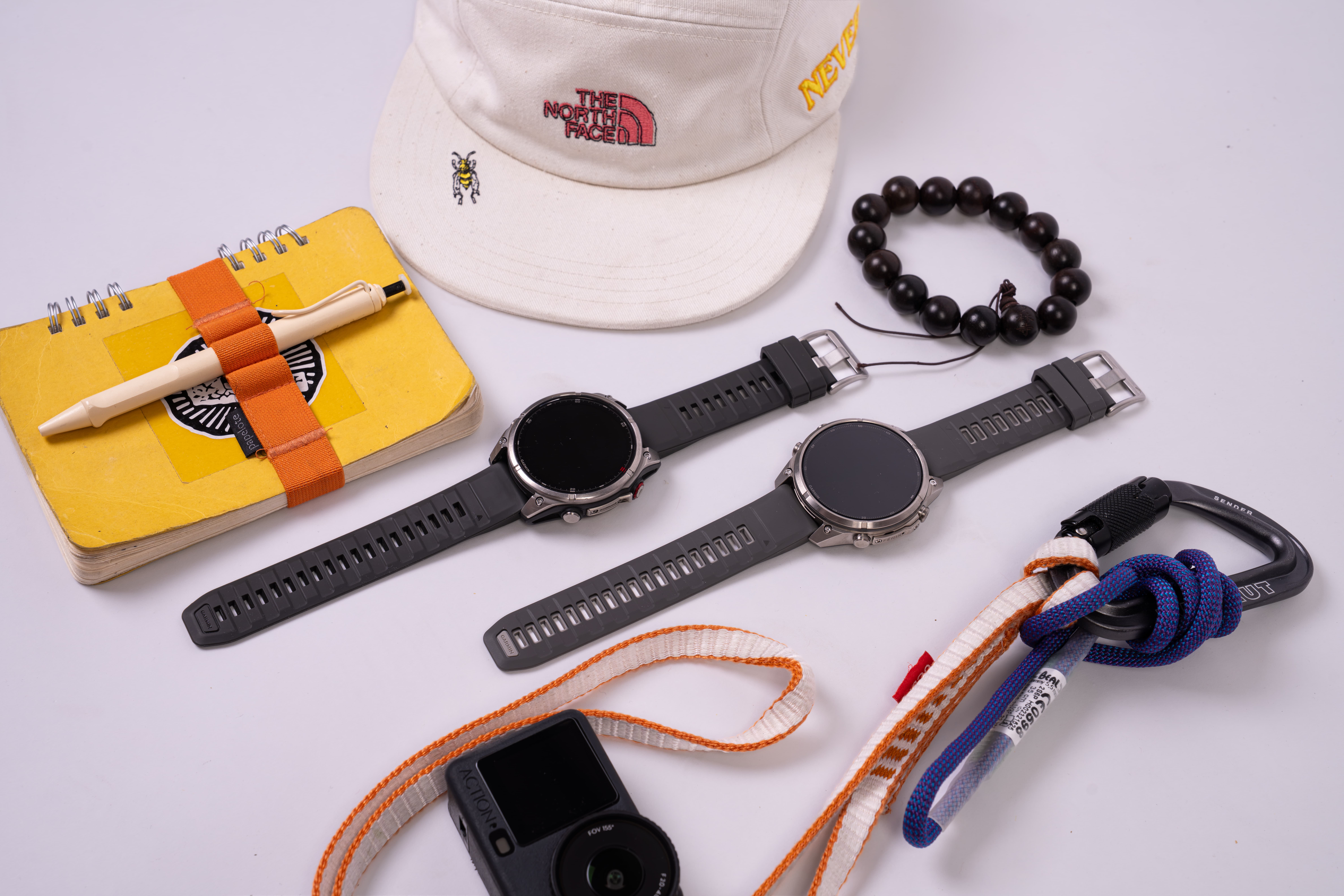
Garmin Fenix 9: The Best Garmin, Which May Have Come Too Soon
Amazfit, with its Zepp platform, has made a huge leap forward over the past two years. Metrics such as VO₂ max, training load, training effect, recovery, BioCharge, and LifeLoad are now at a level that would have been unthinkable for a “budget” brand three years ago. Support for the Stryd footpod or external sensors is a sign that the company is targeting serious athletes. Nevertheless, the ecosystem is smaller, third-party integration is more limited, and some features have restrictions. For example, real-time power measurement and VO₂ max are supported only in the outdoor run, trail run, and track run modes.
Both devices excel at navigation. Amazfit lets you create a route directly on the watch using built-in maps and edit it even while on the go without a phone, share your location via LiveShare, and save up to 100 routes. Garmin offers pre-installed TopoActive routable maps, which, according to the manufacturer, are smoother and more intuitive and provide confidence even when changing routes. Here, however, Amazfit benefits from its display. The same map data looks much more detailed and clearer on the 466 × 466 AMOLED display with a full color palette than on the 260 × 260 MIP display, where fine map details blur together and colors run into one another.
Payments and Smart Features
Garmin Pay is supported directly by a number of banks here. Zepp Pay works through Curve. Both approaches work, but Garmin is more straightforward for the average Czech user. Amazfit, on the other hand, offers a microphone, speaker, and Bluetooth calls—features available on higher-end Fenix models—and Garmin goes even further with its inReach LTE versions, which can handle calls even without a phone.
Comparison Table
| Parameter | Amazfit T-Rex Dual Solar | Garmin Fenix 9 Pro Solar 51 mm |
| Display Type | AMOLED | MIP (transflective) |
| Screen Diagonal and Resolution | 1.32″, 466 × 466 (approx. 353 PPI) | 1.4″, 280 × 280 (approx. 200 PPI) |
| Maximum brightness | 3,000 nits | non-backlit, reflective display, limited color palette |
| Solar Charging | Front heating element + rear glass-ceramic cooktop; they do not heat simultaneously | solar-powered display, worn passively on the wrist |
| Battery Capacity | 660 mAh | does not specify |
| Smartwatches (with or without a solar panel) | 25 days / 34 days for the front panel, 51 days for the back panel | 30 days / 57 days |
| GPS Accuracy Mode | up to 41 hours | up to 54 hours (75 hours with solar power) |
| Dimensions | 51.4 mm, height 16.9 mm (including sensor) | 51 mm, height 16.6 mm |
| Weight | 69 g (body) | 77 g |
| Material | titanium bezel and buttons, polymer frame | all-titanium case |
| Flashlight | white, red | white, red, green |
| Satellite Communications | no | Optional inReach |
| Price in the Czech Republic | 16,449 CZK | 29,490 CZK (31,990 CZK with inReach) |
What does this mean for the market?
Now, let’s address the question in the headline. Has Amazfit taken the wind out of manufacturers’ sails? In one sense, definitely yes.
For years, Garmin has argued that combining AMOLED with solar power doesn’t make sense. Amazfit didn’t prove that Garmin was wrong about the physics. It showed something else: that you can reframe the question. Instead of asking, “How do we get solar power under the AMOLED display?” it asked, “Where else on the watch is there space that no one is using?” The answer is: the back. It’s a classic engineering move that circumvents the problem rather than fighting it head-on. And it’s exactly the kind of idea that will force the rest of the market to rethink things.

At the same time, Amazfit is redefining what solar power means for watches. With Garmin, solar power is a quiet helper you don’t even notice. With Amazfit, it’s a tool you consciously use when you’re far from a power outlet. For the average user who goes on weekend hikes, the difference is minimal, since they charge it at home. But for someone on a week-long trek in Scandinavia who places their watch on their backpack during every break, it can be a real benefit. And for someone whose watch runs out of battery completely, the ability to recharge from the sun is a lifesaver.
From a market perspective, however, something else is more important. For 16,449 CZK, the Amazfit offers an AMOLED display, titanium, sapphire crystal, maps, dual-band GPS, mobile payments, phone calls, and experimental solar charging. That’s a price at which you can buy a Garmin model two tiers lower. This is the real threat to Garmin—not solar charging itself. Every product like this raises the bar for what customers expect for their money and puts pressure on the prices of premium lines.
Garmin appears to be responding in its own way: it has lowered the price of the Fenix 9 compared to the Fenix 8, expanded its lineup to include inReach and titanium models, and, most importantly, is banking on what Amazfit won’t be able to catch up to anytime soon—namely, its ecosystem, trust, and reputation. I don’t believe Garmin won’t try some form of hybrid solar charging with AMOLED in the next generation. Amazfit has shown that the market wants it, and Garmin doesn’t like to let others claim the title of “first.”
To Whom What
The Amazfit T-Rex Dual Solar makes sense if you want a detailed AMOLED display with rich colors and the assurance that you can recharge it without an outlet in a pinch. If you’re drawn to the latest tech and are willing to tinker with the watch a bit—taking it off during breaks and deliberately “feeding” it sunlight. If the Zepp ecosystem is enough for you and you don’t need integration with dozens of third-party services. And if a price difference of around 13,000 Kč matters to you—which it does for most people.
The Garmin Fenix 9 Pro Solar 51 mm makes sense if battery life is your top priority and you want a solar-powered watch that works on its own, without any fuss. If you go on multi-day expeditions, run ultras, or bike all day long. If you’re part of the Garmin ecosystem and don’t want to lose your data history, training plans, or compatibility with the Edge bike computer. If you want optional inReach satellite communication. And if you don’t mind a low-resolution display with a limited color palette—one that reliably shows everything essential but, in terms of detail and image vibrancy, belongs to a different generation.

Garmin Fenix® 9 – 51 mm, Carbon Grey DLC Titanium Black/Pebble 010-04337-16
30 490 €
Premium multisport GPS smartwatch with 51mm titanium case, sapphire crystal and comprehensive sports and navigation features. Water resistant to 100M.
And if you want an AMOLED display but aren’t really that interested in solar charging? Then the most sensible choice is the 51mm Fenix 9 Pro AMOLED, which is 0.8 mm thinner, has the largest display in Fenix history (1.5 inches, 466 × 466), and in smartwatch mode without sunlight, it actually lasts a day longer than the solar version (31 vs. 30 days). Incidentally, this comparison best illustrates just how far Garmin’s AMOLED technology has come: in a large case, the solar-powered MIP display no longer has the edge in battery life, even without sunlight.
Verdict
The Amazfit T-Rex Dual Solar is the most interesting piece of hardware to hit the outdoor watch market this year. Not because it solved the AMOLED and solar charging dilemma, but because it boldly sidestepped it and opened up a new category. Dual-sided solar charging is a true innovation, and the idea of a glass-ceramic back is elegant from a design perspective.
At the same time, it’s important to keep your feet on the ground. Real-world data from the first test show that the gain is minimal in everyday use, the rear panel on the wrist doesn’t work, it overheats in warm weather, and for all that solar technology, you’ve paid for a smaller battery and a smaller display than on its sister model, the Ultra 2. Figures like “up to 51 days” are based on a lab scenario that very few people will ever achieve in real life.
The Garmin Fenix 9 Pro Solar, on the other hand, is an evolution without any surprises. MIP with passive solar charging is a system that works because physics is on its side. It’s not flashy, but it’s reliable, and in the category of watches you rely on for safety in the mountains, that’s an argument you can’t dismiss.
So, has Amazfit taken everyone’s breath away? Technologically speaking, yes, and Garmin will be watching it very closely. As a product for most people, it’s more of a fascinating first version than a finished solution at this point. But that’s exactly how revolutions begin: first, someone does it—even if imperfectly—and then no one can say it can’t be done.
Does the Amazfit T-Rex Dual Solar AMOLED have solar charging?
Yes. The Amazfit T-Rex Dual Solar combines an AMOLED display with a dual-sided solar system. Solar energy is collected from the front of the watch and the back panel.
What is the difference between the solar charging features on the Amazfit T-Rex Dual Solar and the Garmin Fenix 9 Pro Solar?
Garmin uses solar charging continuously while the device is worn on the wrist. In addition to the front solar panel, Amazfit also has a rear panel designed primarily for charging when the device is not on the wrist. Therefore, the two systems work differently.
Which watch has a better display—the Amazfit T-Rex Dual Solar or the Garmin Fenix 9 Pro Solar?
The Amazfit uses an AMOLED display with a resolution of 466 × 466 pixels and a brightness of up to 3,000 nits. The Garmin Fenix 9 Pro Solar has a transflective MIP display with a resolution of 280 × 280 pixels. In terms of resolution, color, and detail, AMOLED has significantly different specifications than MIP.


Comments
No one has commented on this article yet. Be the first.